The Man Behind The Mat: Uncovering the Origins of Pilates
Introduction
Have you ever found yourself, mid-plank or halfway through a set of leg circles, wondering about the origins of the very exercise that has you breaking a sweat? If you’re a Pilates enthusiast – or perhaps a newcomer to the practice – you may be curious about the history of this form of exercise, and more specifically, about the man whose name it bears. The answer lies in the remarkable life and legacy of Joseph Pilates.
The story of Joseph Pilates is as compelling as the exercise method he developed – a story of innovation, resilience, and a relentless pursuit of health and wellbeing. It is a story that is sure to add a new layer of appreciation to your next Pilates workout, whether it’s on the mat or reformer. So, let’s dive into the fascinating world of Joseph Pilates, the man who pioneered a fitness revolution that continues to transform bodies and lives around the globe.
In this post, we’ll be exploring the life of Joseph Pilates, his unique philosophy on physical fitness, and how he developed two of the most popular forms of Pilates practiced today: mat Pilates and reformer Pilates. We’ll delve into his early years in Germany, his time in England during World War I, and how these experiences shaped his understanding of health and fitness. We’ll also discuss how he came to create his exercise methods and the principles that underpin them.
Joseph Pilates’ story is not just about the birth of a popular exercise regime; it’s about a revolutionary approach to physical and mental wellness that remains just as relevant today as it was in the early 20th century. His methods have stood the test of time, with millions of people worldwide now practicing Pilates to strengthen their bodies, improve flexibility, reduce stress, and enhance overall wellbeing.
Understanding the origins and principles of Pilates can enrich your own practice and deepen your appreciation for this powerful form of exercise. It’s not just about knowing the difference between a ‘hundred’ and a ‘teaser’; it’s about understanding why you’re doing these exercises and the benefits they can bring to your body and mind.
Whether you’re a seasoned Pilates practitioner, a complete beginner, or a fitness professional, learning about Joseph Pilates will provide you with valuable context and insight. It’s about understanding the ‘why’ behind the ‘what’, and this understanding can be a powerful motivator, helping you to remain committed to your Pilates practice even when the going gets tough.
As we unfold Joseph Pilates’ journey, we’ll also be looking at how his methods have evolved over time and the impact they’ve had on the world of fitness. We’ll explore how mat Pilates and reformer Pilates differ from each other, as well as the benefits each one can offer. This is a chance to deepen your understanding of Pilates, to appreciate its roots, and to harness its power for your own wellbeing.
So, get comfortable (maybe stretch out those hip flexors while you read), and join us on this exploration of Joseph Pilates’ life and legacy. Whether you’re here out of sheer curiosity or with the intent to power up your Pilates practice, there’s something in this story for everyone. After all, Pilates is more than just an exercise – it’s a lifestyle, a philosophy, and an enduring testament to the power of movement for overall health and wellness.
In essence, knowing more about Joseph Pilates is not just about discovering historical facts; it’s about understanding why you’re moving the way you do during your Pilates workout. It’s about realizing the reason behind every stretch, every pulse, every controlled breath you take. It’s about connecting with the foundation of a practice that emphasizes balance, strength, flexibility, and mindfulness. It’s about acknowledging and appreciating the man who embarked on a quest for an ideal fitness regimen and ended up gifting the world with a timeless method: Pilates.
The Fundamentals and Framework: Unfolding Joseph Pilates and His Revolutionary Fitness System
Joseph Pilates, a name synonymous with physical fitness and health, created a revolutionary body conditioning routine that not only focused on balancing the body but also emphasized mental well-being. Today, his technique, known simply as Pilates, is practiced worldwide by fitness enthusiasts looking for a holistic approach to physical wellness.
Born in Germany in 1883, Joseph Pilates was frail as a child, suffering from asthma, rickets, and rheumatic fever. Determined to overcome his physical ailments, he began studying various forms of exercise, including yoga, martial arts, gymnastics, and bodybuilding. In his quest for a comprehensive workout regimen that would strengthen both mind and body, Pilates developed a series of movements that combined elements of Western and Eastern philosophies of fitness.
During World War I, Pilates was interned in England as an “enemy alien.” While in the internment camp, he taught others his unique exercise system, which he initially called “Contrology.” He even rigged springs to hospital beds, creating an innovative form of resistance exercise for patients who were bedridden, thus laying the groundwork for his later equipment-based exercises.
After the war, Pilates returned to Germany and briefly worked as a self-defense trainer. However, the political climate led him to emigrate to the United States in 1926. En route to America, he met his future wife Clara, who would become an integral part of his life and work.
Once in New York City, Joseph and Clara opened a fitness studio introducing the Pilates method to a broader audience. Their gym attracted a diverse clientele, including dancers, athletes, and celebrities attracted by the promise of an exercise routine that could improve posture, balance, flexibility, and strength without adding bulk.
At the heart of Joseph Pilates’s method is the concept of ‘contrology.’ He believed in the power of the mind to control the muscles, emphasizing smooth, precise, and flowing movements to connect the body and mind. Pilates exercises focus on core strength, breath control, and spinal alignment to enhance physical balance, strength, and flexibility.
Pilates developed more than 500 unique exercises for his regimen. The mat exercises, which are probably the most well-known, require only a floor mat and training. Other exercises utilize several unique pieces of equipment that Pilates designed and built himself, such as the Reformer, Cadillac, and Wunda Chair.
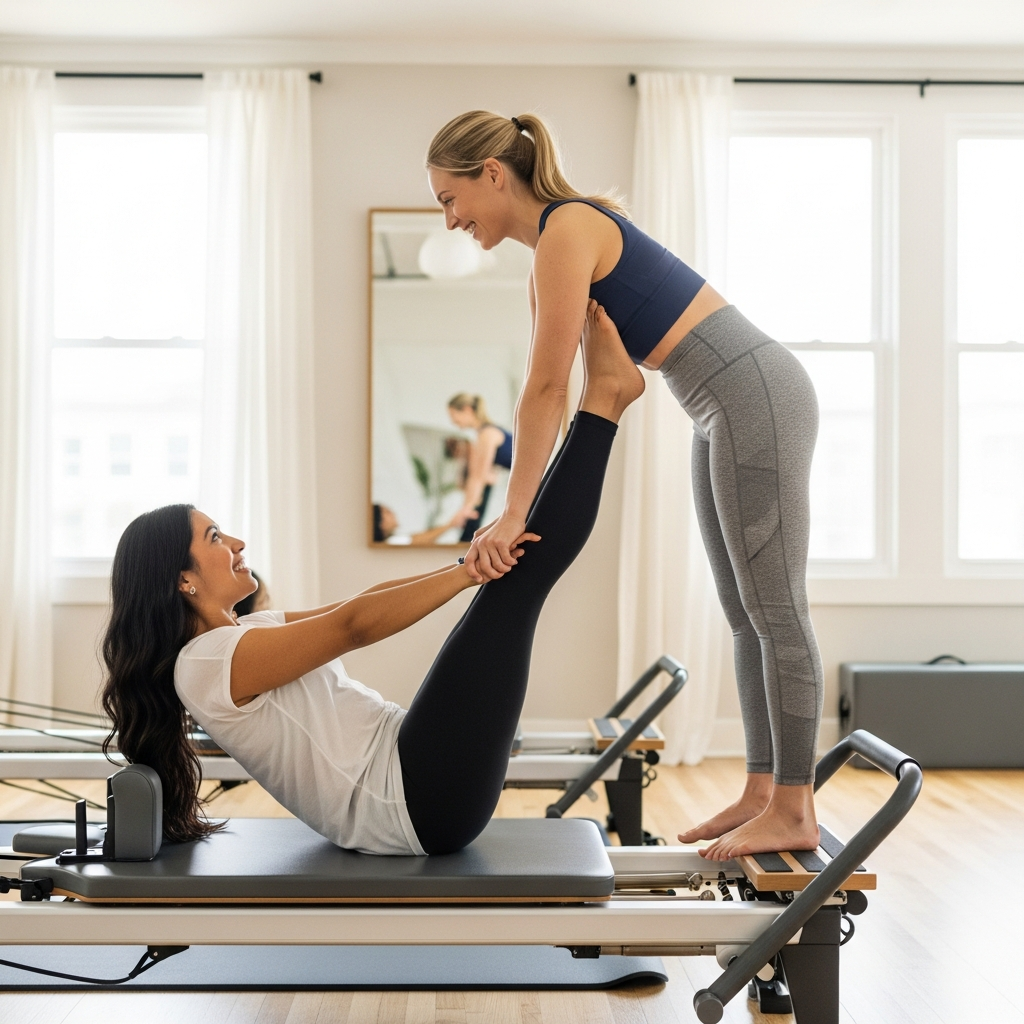
The Reformer, the most famous piece of Pilates equipment, is a bed-like frame with a flat platform on it, called the carriage, which rolls back and forth on wheels. The carriage is attached to one end of the reformer by a set of springs that provide differing levels of resistance as the carriage is pushed or pulled along the frame. The Cadillac is a type of trapeze table used for a wide variety of exercises performed lying down, sitting, standing, pulling the straps, pushing against the poles, and more. The Wunda Chair is a small piece of equipment that looks like a box with one side that can be pushed down against the resistance of springs like a large pedal.
Joseph Pilates authored two books related to his training method: “Your Health: A Corrective System of Exercising That Revolutionizes the Entire Field of Physical Education” in 1934, followed by “Return to Life Through Contrology” in 1945. In these books, he outlined the philosophical framework and benefits of Pilates.
Pilates continued to teach and develop his fitness system until his death in 1967 at the age of 83. Despite passing away over five decades ago, Joseph Pilates’s impact on the world of fitness continues. His revolutionary approach to whole-body wellness remains more relevant than ever in our increasingly health-conscious society.
Pilates’s legacy lives on through the method he created, now known worldwide simply as Pilates. Today, millions of people practice Pilates, and its popularity only continues to grow. It is a testament to Joseph Pilates’s insight and foresight that his methodology remains a significant part of the fitness landscape, helping countless individuals achieve greater physical and mental harmony.
In conclusion, Joseph Pilates was not just the founder of a fitness routine; he was a visionary who revolutionized the way we perceive and practice physical fitness. His life and work have left an indelible mark on the world of health and wellness, with his holistic approach to exercise offering a balanced way to achieve physical well-being and mental peace.
The Legacy of Joseph Pilates: A Comprehensive Guide
For many, the term Pilates is synonymous with a highly effective form of exercise that focuses on balance, strength, flexibility, and mind-body connection. However, few know about Joseph Pilates, the visionary behind this holistic workout regimen. His work has transformed countless lives, empowering individuals to achieve better health and physical fitness.
Born in 1883 in Mönchengladbach, Germany, Joseph Hubertus Pilates was a frail child suffering from various physical ailments. Determined to overcome his physical challenges, he embarked on a lifelong journey exploring body conditioning and muscle development. He studied gymnastics, yoga, martial arts, and even ancient Greek and Roman fitness philosophies. This exploration culminated in what we now call Pilates.
Let us delve more into the life of Joseph Pilates and how his principles can be applied to your Pilates routine, regardless of whether you prefer mat or reformer Pilates.
1. Embracing the Philosophy of Contrology
Joseph Pilates formulated a system he called “Contrology” – the science of control. He believed that mental and physical health are interconnected and that exercise should involve the whole body. Pilates exercises require you to engage your mind to control your muscles, focusing on smooth, precise movements.
Actionable advice: When practicing Pilates, don’t rush through the exercises. Instead, concentrate on controlled motions and proper breathing techniques. For example, in mat pilates, as you perform ‘The Hundred’, a classic Pilates move, focus on your breathing as you rhythmically move your arms and hold your legs in tabletop position.
2. Incorporating the Six Pilates Principles
Joseph Pilates emphasized six principles: Centering, Concentration, Control, Precision, Breath, and Flow. These principles are integral to both mat and reformer Pilates and provide numerous benefits such as improved posture, increased flexibility, and enhanced concentration.
Actionable advice: In your next Pilates session, try to incorporate all six principles. For instance, while performing the ‘Reformer Footwork’ in reformer Pilates, focus on your center (the powerhouse), maintain control and precision in your movements, coordinate your breath with each movement, and ensure a smooth flow throughout the exercise.
3. Understanding the Role of Apparatus
Joseph Pilates designed several pieces of equipment to enhance his exercises. The most well-known is the reformer, a bed-like frame with a flat platform that rolls back and forth on wheels. The reformer adds resistance to the Pilates exercises via the use of the springs which can be adjusted to different levels of difficulty.
Actionable advice: If you’re used to mat Pilates and want to challenge yourself further, consider trying reformer Pilates. Start with simple exercises such as ‘Footwork’ or ‘Leg Circles’ to get used to the resistance offered by the reformer.
4. Appreciating the Universality of Pilates
Joseph Pilates firmly believed that his method was more than just a collection of exercises; it was a way of life. He intended Pilates to benefit everyone, regardless of age or fitness level. Whether you’re a professional athlete or a senior citizen looking to stay active, Pilates can be tailored to suit your needs.
Actionable advice: Don’t be intimidated by the complexities of some Pilates exercises. Start with basic mat exercises like ‘Pelvic Curl’ or ‘Spine Twist’. As you build strength and flexibility, gradually introduce more advanced moves.
In conclusion, Joseph Pilates has left us an invaluable legacy: a holistic approach to fitness that is as relevant today as it was in the early 20th century. By understanding and implementing his philosophies and principles, we can lead healthier, more balanced lives. So, whether you’re practicing mat or reformer Pilates, remember to embody the essence of Contrology – the harmonious union of mind, body, and spirit.
Joseph Pilates: Common Challenges, Solutions, and Expert Tips
Joseph Pilates, a name synonymous with core strength and flexibility, was the genius behind the fitness regimen that has revolutionized the world of wellness. Yet, many misconceptions exist about Pilates, his method, and its various forms like mat and reformer Pilates. Let’s debunk these myths, address common challenges, and provide solutions and expert tips for a better understanding of this incredible exercise form.
**Misconceptions and Myths**
1. *Pilates is only for women*: One of the most prevalent misconceptions is that Pilates is a female-centric workout. Joseph Pilates was a man who originally developed this method as a rehabilitation program for soldiers during World War I. The practice is beneficial for all genders due to its focus on core strength, flexibility, balance, and overall body awareness.
2. *Pilates is easy*: Pilates is often categorized as a light workout, but in reality, it can be incredibly challenging. It requires intense focus and concentration as it is not about completing numerous repetitions but performing each movement with precision.
3. *You need to be flexible to do Pilates*: Many people believe that you need to be naturally flexible to participate in Pilates. On the contrary, Pilates helps increase your flexibility. It’s about control and precision, no matter your starting point.
**Common Challenges and Solutions**
1. *Difficulty in maintaining focus*: Pilates requires concentration to connect your mind and body. If you find it challenging to maintain focus during your sessions, try practicing mindfulness outside of class. Meditation or simple breathing exercises can help improve your concentration levels.
2. *Muscle soreness*: Like any new exercise regimen, Pilates can lead to muscle soreness due to its focus on precise movements and muscle control. Ensure you warm up properly before each session and cool down afterwards. Incorporating gentle stretching and maintaining hydration can also help alleviate muscle discomfort.
3. *Understanding the breath-work*: Joseph Pilates emphasized the importance of correct breathing with his principle – ‘Breath is life’. However, coordinating breath with movement can be challenging for beginners. Practice simple breathing exercises at home to get the hang of inhaling and exhaling at the right time.
**Expert Tips**
1. *Start with a beginner’s mind*: No matter your fitness level, when starting Pilates, approach it as a beginner. This helps understand the basics thoroughly and build a solid foundation.
2. *Quality over quantity*: In Pilates, it’s not about how many reps you do, but how well you do them. Concentrate on precision and control.
3. *Invest in a good mat*: For mat Pilates, investing in a good-quality mat can make a significant difference. Your mat is your space, and it should be comfortable and supportive.
4. *Try different forms*: Don’t limit yourself to just one form of Pilates. Both mat and reformer Pilates have their unique benefits. Mat Pilates is great for focusing on core strength and can be done anywhere, while reformer Pilates provides resistance training, making it a more intense workout.
5. *Consistency is key*: Like any exercise regimen, consistency is crucial for seeing results in Pilates. Make it a part of your regular workout schedule.
Joseph Pilates once said, “In ten sessions, you’ll feel the difference, in twenty you’ll see the difference, and in thirty you’ll have a whole new body.” Embrace the method with understanding and patience. Whether you prefer mat or reformer Pilates, remember that every movement you make brings you one step closer to enhanced physical strength, flexibility, and mental awareness.
Joseph Pilates: His Legacy and the Evolution of Pilates
Joseph Pilates, the founding father of the Pilates method, is a figure of immense importance to anyone embarking on a Pilates journey. Understanding his philosophy, methodology, and the motivation behind the creation of this transformative discipline will enrich your practice and provide a robust foundation for your Pilates education.
Born in Germany in 1883, Joseph Pilates was a frail child who suffered from asthma, rickets, and rheumatic fever. Determined to overcome his physical ailments, he dedicated his life to improving his health and fitness. His quest led him to study yoga, martial arts, gymnastics, and weightlifting, among other disciplines. These influences are deeply embedded in Pilates as we know it today.
In the 1920s, Pilates invented an exercise regimen for injured dancers and soldiers while living in the UK. He called this method “Contrology,” emphasizing the mind-body connection. His system aimed to develop controlled movements from a strong core, emphasizing alignment, breathing, developing a strong powerhouse, and improving coordination and balance.
After immigrating to the United States in 1926, Joseph and his wife Clara opened a fitness studio in New York City. Their method quickly became popular among dancers for its rehabilitative effects. Pilates continued to develop and refine his method until his death in 1967. Today his method lives on, split into two main streams: Classical Pilates (which sticks closely to Joseph’s original work) and Contemporary/Modern Pilates (which includes adaptations and variations made by various trainers and physiotherapists over the years).
If you’re starting with Pilates, you’ll likely encounter two main types: Mat Pilates and Reformer Pilates.
Mat Pilates is typically the starting point for most practitioners. As the name suggests, these exercises are performed on a mat, using your own body weight for resistance. Mat Pilates focuses on developing core strength, flexibility, balance, and stamina. A typical class will take you through a sequence of controlled movements that engage your body and mind. Don’t let the simplicity fool you; Mat Pilates can be extremely challenging, even for seasoned athletes.
Reformer Pilates, on the other hand, is performed on a specially designed machine called a Reformer. It consists of a flat platform called a carriage that moves back and forth along tracks within a frame. The carriage is attached to one end of the reformer by a set of springs that provide differing levels of resistance. Reformer Pilates offers a more intense workout and allows for a wider variety of exercises than Mat Pilates. It’s excellent for rehabilitation purposes, as it allows the practitioner to work in a supported and controlled environment.
In terms of timeline and progression, remember that Pilates is not a quick fix – it’s a journey. Most practitioners start to feel a difference in their body after about ten sessions and see visible changes in about twenty sessions. However, these numbers can vary widely depending on factors such as your fitness level, frequency of practice, and diet.
For beginners, it’s advisable to start with two to three Mat Pilates classes per week for the first six weeks. This frequency provides an excellent foundation and helps to develop the necessary muscle memory. As you become more comfortable, you can explore Reformer Pilates or even private sessions to further challenge yourself and deepen your practice. Make sure to listen to your body and progress at your own pace.
Remember, the goal of Pilates is not just physical fitness; it’s about creating a synergy between mind and body. As Joseph Pilates said, “Physical fitness is the first requisite of happiness.” So embrace the journey, and welcome to the world of Pilates!
In conclusion, Joseph Pilates was not only an innovator but an individual who revolutionized the world of fitness and wellness. His story is one of resilience, determination, and a relentless pursuit of holistic health. Pilates was a man ahead of his time, combining elements of Western and Eastern philosophies to create a form of exercise that emphasizes the balance between mind and body. His exercises, as well as his innovative equipment like the Reformer, have stood the test of time and continue to be pivotal in the world of fitness today.
Joseph Pilates’ philosophy of exercise was rooted in the belief that physical health and mental health are interrelated. He asserted that poor posture, sedentary lifestyles and inefficient breathing were the roots of poor health. His approach to wellness was comprehensive and all-encompassing – a concept that is only now gaining traction and acceptance in our modern society.
His method, known as Contrology during his lifetime, transformed into what we now know as Pilates – a widely respected and practiced form of exercise. Pilates is not merely a collection of exercises but a method that develops strength, flexibility, coordination, balance, and mental awareness. The beauty of Pilates lies in its adaptability to different fitness levels and needs. Whether you’re an athlete looking to enhance your performance or someone recovering from an injury, Pilates can be tailored to suit your individual requirements.
The principles Joseph Pilates established – concentration, control, centering, flow, precision, and breathing – are as relevant today as they were during his life. These principles are not just the foundation of Pilates, but they also offer valuable lessons for our everyday life. They teach us about the importance of mindfulness, the power of our core (both physically and metaphorically), the need for fluidity in our actions, the value of precision, and the vital role of breath as a life force.
It’s also important to remember that Pilates was not just about exercise. It was about a way of life. Joseph Pilates firmly believed in the power of good nutrition, adequate sleep, and fresh air. He advocated for a holistic approach to health and wellness, which aligns perfectly with our modern understanding of a balanced lifestyle.
To fully appreciate Pilates, it’s essential to understand its roots and the man behind it. Joseph Pilates’ life, philosophy, and dedication to wellness have made an indelible impact on the world of fitness and beyond. His method is not just a testament to his genius but a gift that continues to positively influence people’s lives, proving that his legacy is not only enduring but also continuously evolving.
As you embark or continue on your Pilates journey, remember that it’s more than just a workout. It’s a philosophy and a way of life that can lead to better health, improved mental clarity, and overall wellbeing. Always keep in mind the principles that Joseph Pilates taught, and strive to incorporate them not just in your exercise routine but also in your daily life.
We hope that this exploration into the life of Joseph Pilates has deepened your understanding of this remarkable man and the extraordinary legacy he left behind. If you need further assistance or guidance as you explore the world of Pilates, don’t hesitate to reach out to us. Our team is made up of dedicated professionals who share Joseph Pilates’ passion for wellness and are ready to help you on your journey towards a healthier, more balanced life.
Remember, every journey begins with a single step. Take that step today by contacting us. Let the principles of Joseph Pilates guide you towards achieving your health and wellness goals. After all, in the words of Joseph Pilates himself, “Physical fitness is the first requisite of happiness.” Let’s embark on this journey of happiness together.