Unraveling the Power of Pilates: An In-depth Exploration of Mat and Reformer Pilates
Are you tired of workout routines that push your body to its limits, leaving you exhausted rather than invigorated? Or maybe you’re searching for a fitness approach that not only strengthens and tones your body but also enhances flexibility, balance, and mind-body connection? If that’s the case, you may be ready to dive into the world of Pilates.
Pilates is not just another fitness fad; it’s a holistic approach to health and wellness that has stood the test of time. Developed in the early 20th century by Joseph Pilates, this unique exercise method has been enhancing physical strength, flexibility, and overall well-being for over a century. But what exactly is Pilates? How does it work? And more importantly, how can it benefit you?
In this comprehensive guide, we will delve into the nuts and bolts of Pilates, providing you with an in-depth understanding of this powerful workout. Whether you’re a fitness enthusiast seeking to expand your workout repertoire or a beginner looking for a gentle yet effective way to get in shape, this exploration of Pilates is sure to provide you with valuable insights.
We’ll start by examining the core principles of Pilates, shedding light on its focus on controlled movements and body-mind harmony. Then, we’ll move on to explore two of the most popular types of Pilates – Mat Pilates and Reformer Pilates. While both types share the foundational principles of Pilates, they each offer a unique twist on this classic workout method.
Mat Pilates, as the name suggests, is performed on a mat and utilizes your own body weight as resistance. On the other hand, Reformer Pilates involves a specialized piece of equipment—the reformer—and offers increased resistance and support, making it suitable for a wide range of fitness levels. By comparing and contrasting these two types of Pilates, we’ll help you determine which one might be the best fit for your personal fitness goals and needs.
But the exploration won’t stop there. We will also delve into the numerous benefits of Pilates, from improved core strength and posture to enhanced mind-body awareness. We’ll even touch on how Pilates can complement other forms of exercise and contribute to a well-rounded fitness regimen.
So why should this matter to you? With so many fitness options available, it can be overwhelming to choose the right one for you. Understanding the principles and benefits of Pilates can empower you to make an informed decision about your fitness journey. Moreover, this guide will equip you with the knowledge you need to get the most out of whichever form of Pilates you choose to pursue.
Whether you’re looking to boost your fitness level, recover from an injury, or simply find a workout that nourishes both your body and mind, Pilates could be the perfect fit. So, are you ready to unravel the power of Pilates? Let’s dive in and discover what this dynamic workout method has to offer.
Stay tuned as we embark on this exciting journey through the world of Pilates, revealing its principles, practices, and profound potential benefits along the way. With a deeper understanding of what Pilates truly entails, you’ll be well on your way to achieving a stronger, more flexible, and harmoniously balanced body and mind.
Pilates is a method of exercise that consists of low-impact flexibility, muscular strength, and endurance movements. It emphasizes proper postural alignment, core strength, and muscle balance. Named after its creator, Joseph Pilates, this innovative workout regime was developed in the early 20th century as a rehabilitation program for the war-wounded. Over time, Pilates has evolved into a popular fitness method that is practiced worldwide.
The core philosophy of Pilates revolves around the concept of ‘contrology’. Joseph Pilates believed in the power of the mind to control muscles. He espoused the idea that the body and mind must work together to achieve optimum health. Pilates focuses on quality over quantity. One properly executed movement is worth more than several poorly performed ones. The goal is to make the most efficient use of your time by performing fewer, more precise movements, thereby reaching the levels of intensity that previously could only be achieved through a long duration workout.
Pilates is not restricted to a specific equipment or environment. It can be done on a mat using props like balls, resistance bands, and magic circles, or on specialized equipment like reformers and Cadillac machines. This versatility makes Pilates accessible to a wide range of people.
The framework of Pilates is built on six key principles: Centering, Concentration, Control, Precision, Breath, and Flow.
Centering pertains to physically bringing the focus to the center of the body, the powerhouse area between the lower ribs and pubic bone. All Pilates exercises emanate from the powerhouse and flow outward to the limbs.
Concentration promotes the mind-body connection. You must be fully aware of your body and how it moves to gain full benefit from Pilates exercises. Here, quality trumps quantity.
Control means using your mind to control your body. Every exercise is done with control; the muscles control the movement of the body and the apparatus.
Precision is integral in Pilates. The focus is on doing one precise and perfect movement, rather than many half-hearted ones. The goal is for this precision to eventually become second nature, and carry over into everyday life as grace and economy of movement.
Breath is the life force. Joseph Pilates emphasized using a very full breath in his exercises. He advocated thinking of the lungs as a bellows, using them strongly to pump the air fully in and out of the body. Most Pilates exercises coordinate with the breath, and using the breath properly is an integral part of Pilates exercise.
Flow, the final principle, creates smooth, graceful, and functional movements. Transitioning smoothly from one move to the next provides a cardiovascular benefit and increases strength.
In summary, Pilates is a comprehensive workout that targets the whole body, with a special emphasis on core strength. It can help improve posture, muscle tone, balance, and joint mobility, as well as relieve stress and tension. The flexibility of the workout allows for modifications to suit all levels from beginners to advanced. A regular practice of Pilates can contribute to overall well-being and significantly improve physical health. In the words of Joseph Pilates himself, “In ten sessions you’ll feel the difference, in twenty you’ll see the difference, and in thirty you’ll have a whole new body.”
Understanding Pilates: A Comprehensive Guide to Your Total Body Workout
Pilates is a fitness system developed in the early 20th century by Joseph Pilates, a physical trainer from Germany. The workout regime was designed to improve physical strength, flexibility, posture, and enhance mental awareness. Pilates can be performed on a mat, often referred to as ‘mat Pilates’, or on a reformer, an apparatus specifically designed for Pilates workouts, known as ‘reformer Pilates’.
Mat Pilates:
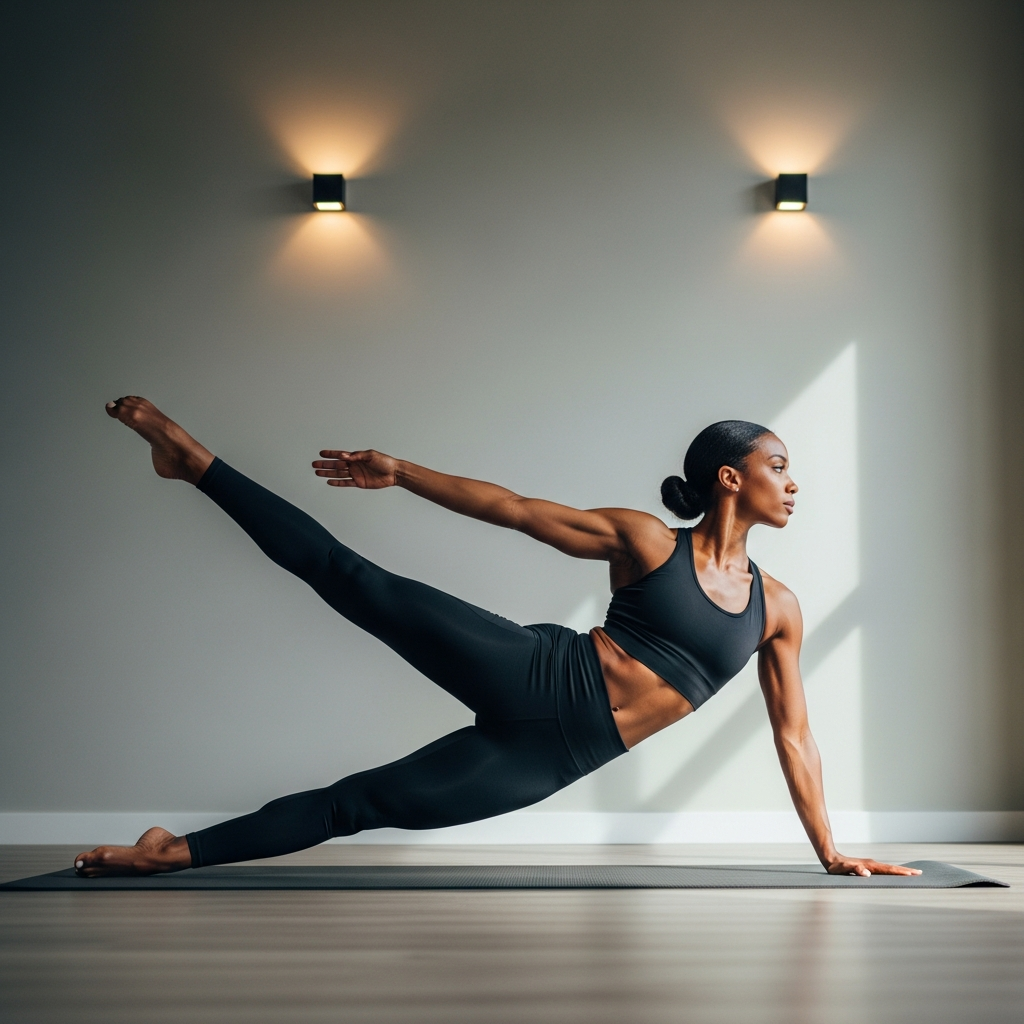
Mat Pilates is an excellent starting point for beginners to the Pilates method. The exercises are performed on a mat, using your own body weight as resistance. Mat Pilates focuses on core strength and stability.
A typical mat Pilates class may include the following steps
1. Warm-Up: Start by standing tall, feet hip-width apart. Roll your shoulders back and down, engage your core muscles, and take deep breaths.
2. The Hundred: This exercise is a classic staple in Pilates. Lie flat on your back with your legs in tabletop position (bent at the knee and lifted). Raise your head and shoulders off the mat and pump your arms up and down while inhaling for five counts and exhaling for five counts.
3. Roll-Up: This exercise targets the abdominals and promotes spinal articulation. Start by lying flat on your back with arms extended overhead. Inhale to lift your arms towards the ceiling and peel your upper body off the mat, rolling up to a seated position. Exhale as you slowly roll back down.
4. Leg Circles: This exercise improves hip mobility and strengthens the core. Lie on your back with one leg extended towards the ceiling and the other flat on the mat. Circle the raised leg in controlled movements while keeping the hips still.
5. Cool Down: Finish with some gentle stretches to relax the muscles and increase flexibility.
Reformer Pilates:
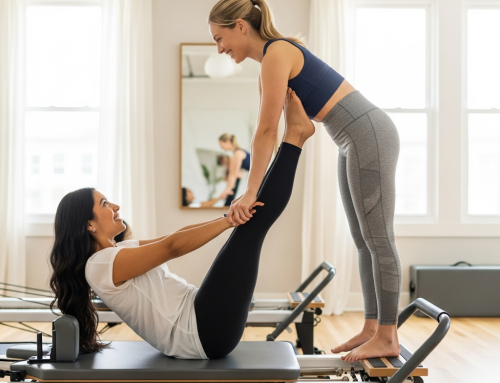
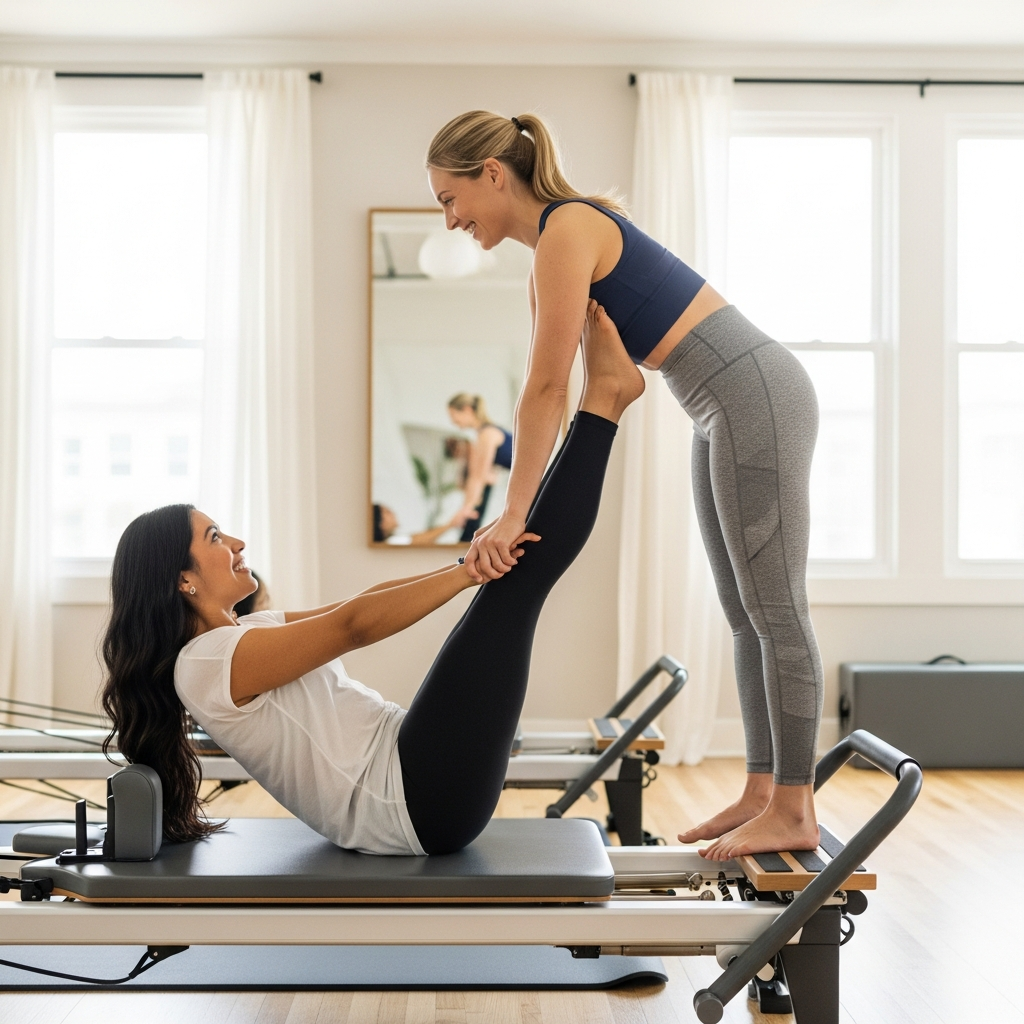
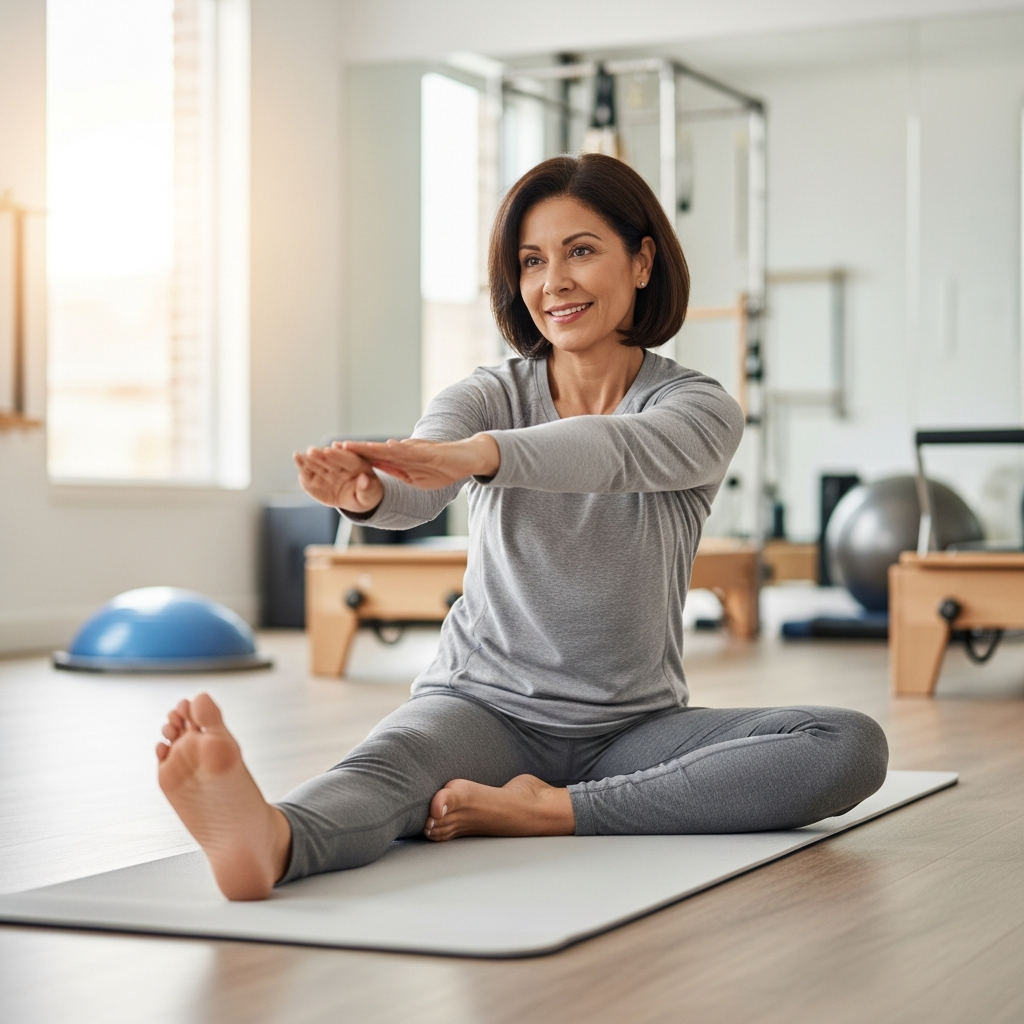
Reformer Pilates, on the other hand, is performed on a sliding carriage within a frame. The resistance is provided by the user’s body weight and the springs attached to the carriage. This type of Pilates is more intense and challenging than mat Pilates, targeting not only the core but also the arms and legs.
A typical reformer Pilates session might include
1. Footwork: Start lying down, with your feet on the footbar, knees bent, and arms resting by your side. Push against the footbar to straighten your legs and then bend your knees to return to the starting position.
2. Leg Press: This exercise targets the lower body. Start in the same position as for footwork but place one foot in the center of the footbar and extend the other leg towards the ceiling. Press against the footbar to straighten the supporting leg then bend your knee to return to the starting position.
3. Arm Work: Attach hand straps to the reformer for upper body exercises. You can perform bicep curls, tricep extensions, or rows while maintaining core stability.
4. Short Spine: This advanced exercise promotes spinal articulation and flexibility. Start lying down with both feet in the straps. Inhale as you extend your legs and lift your hips off the carriage, rolling up onto your shoulders. Exhale as you articulate your spine back down onto the carriage.
5. Cool Down: As with mat Pilates, end your session with some gentle stretching.
Practicing Pilates regularly can lead to numerous health benefits, including improved posture, increased muscle tone and flexibility, enhanced balance and coordination, reduced stress, and even relief from back pain. Whether you prefer mat or reformer Pilates, both methods provide an effective full-body workout that strengthens the core and improves overall fitness.
Remember, it’s important to perform exercises with proper form to avoid injury. If you’re new to Pilates, consider taking a few classes with a certified instructor to learn the basics before attempting exercises on your own. In time, Pilates can become a valuable part of your regular fitness routine, helping you achieve a balanced body and mind.
The Pilates Workout: Common Challenges, Solutions, and Expert Tips
Pilates, a mind-body exercise system developed by Joseph Pilates in the early 20th century, is gaining popularity worldwide due to its numerous health benefits. However, many people are still unsure about what Pilates is and how it benefits their body and mind. Here, we will delve into the specifics of this workout, address common misconceptions, and offer expert tips to enhance your Pilates experience.
Pilates is a low-impact workout that aims to strengthen the body’s core, which includes the muscles of the abdomen, lower back, hips, and thighs. It focuses on improving flexibility, strength, balance, and body awareness. There are two main types of Pilates – mat Pilates and reformer Pilates.
Mat Pilates is performed on a mat and utilizes body weight and gravity to challenge the body. It focuses on control, precision, and concentration. On the other hand, reformer Pilates is performed on a machine (reformer) and incorporates resistance through springs to challenge the body. Both types serve to enhance mind-body connection and overall wellness.
Misconception 1: Pilates is Easy The idea that Pilates is an easy workout is one of the most common misconceptions about the practice. While it’s true that Pilates is low-impact and safe for all fitness levels, it does not mean it’s easy. The exercises require intense focus, precise control, strength, and flexibility. You’re working against resistance (either your body weight or the reformer springs) and targeting specific muscle groups, which can be quite challenging.
Solution: Start at your own pace. Begin with basic exercises to understand the principles of Pilates – control, concentration, centering, precision, breath, and flow. Once you master these principles, gradually increase the intensity and complexity of the exercises.
Expert Tip: Always prioritize quality over quantity. It’s better to perform fewer repetitions correctly than many with poor form.
Misconception 2: Pilates Only Works Your Core While Pilates is well-known for its focus on core strength, it’s a full-body workout. It works every muscle group, improves posture, increases flexibility, and enhances functional fitness.
Solution: Ensure you’re performing a variety of exercises that target all body parts. A well-rounded Pilates workout should include exercises for the core, lower body, upper body, and flexibility work.
Expert Tip: Regularly change your workout routine to challenge different muscles and prevent plateaus.
Misconception 3: You Need Expensive Equipment to do Pilates While reformer Pilates does require a machine, mat Pilates can be done with minimal equipment – all you need is a Pilates mat. Many mat exercises also incorporate small props like resistance bands, magic circles, or Pilates balls, but these are optional.
Solution: Start with mat Pilates if you’re new to the practice or working out at home. Consider joining a studio or gym that offers reformer classes if you want to try reformer Pilates.
Expert Tip: Invest in a good-quality, thick Pilates mat for comfort and support during mat workouts.
Pilates is a versatile and adaptable workout suitable for everyone regardless of age or fitness level. It helps improve physical strength, flexibility, posture, mental awareness and reduces stress. It’s a practice that challenges your body and mind in a gentle yet effective way. Remember to listen to your body, move at your own pace, and most importantly – enjoy the process. With consistent practice and patience, you’ll see improvements not just in your physical fitness but also in your overall wellbeing.
Unveiling the Pilates Experience: Expectations, Timelines, and Next Steps
Pilates, a body conditioning routine, can help build flexibility, improve muscle strength, and enhance mental awareness. It’s a workout that focuses on your body’s core — the abdomen, obliques, lower back, inner and outer thighs, butt, and so on. Pilates also emphasizes proper postural alignment, core strength and muscle balance. So, what exactly is involved in a Pilates workout, how long will it take to see results, and what’s the journey like? Let’s delve in.
Pilates can be categorized into two major types: Mat Pilates and Reformer Pilates.
Mat Pilates is performed on a mat and uses your body weight as resistance. It’s a great starting point for beginners because it introduces you to the basic principles of Pilates such as centering, concentration, control, precision, breath, and flow. These exercises target the deep muscles of the abdomen and spine to strengthen the body from the inside out in a non-impact manner.
Reformer Pilates, on the other hand, happens on a machine called a reformer. It’s more intense and more dynamic than mat work because it adds resistance to the Pilates exercises via the use of the springs which form part of the machine. The primary focus is on the integration of the trunk, pelvis and shoulder girdle.
Now that we understand what Pilates involves, let’s talk timelines. The time it takes to see results from Pilates varies based on several factors including your fitness level, your age, the intensity of your workouts, and how often you do them. However, Joseph Pilates himself was quoted as saying; “In 10 sessions, you feel better, 20 sessions you look better, 30 sessions you have a completely new body.”
It’s important to note that Pilates is not a quick fix. It’s a gradual process that requires regular practice and commitment. Most practitioners recommend doing Pilates at least two to three times a week. If you’re able to maintain that, you can expect to see changes within a couple of weeks to a few months.
Now, let’s talk about the next steps for someone interested in starting Pilates.
First, you’ll need to choose between mat and reformer Pilates. Mat classes tend to be less expensive and more widely available, but some people find reformer classes more challenging. You might also consider starting with private lessons if you have any health concerns or are feeling anxious about joining a group class.
Second, you’ll want to find a qualified instructor. Look for someone who has completed a comprehensive Pilates training program, ideally one that included anatomy, physiology, and at least 500 hours of supervised teaching.
Third, invest in comfortable clothes that allow you to move freely. You’ll be doing exercises that involve stretching and bending, so avoid clothes that are too loose or too tight. Also, while most Pilates studios provide mats, you might prefer to bring your own.
Lastly, remember that Pilates is a journey, not a destination. Don’t be discouraged if you find the exercises challenging at first. With patience and persistence, you’ll get stronger and more flexible over time.
In conclusion, Pilates is a versatile workout that can be adapted to many fitness levels and needs. Whether you choose mat or reformer Pilates, with regular practice and a committed mindset, you’ll feel better, move better, and look better. As with any exercise regimen, it’s advisable to consult with your doctor before beginning, especially if you have any pre-existing health conditions. Enjoy your Pilates journey!
In conclusion, Pilates is a comprehensive and holistic workout that focuses on enhancing flexibility, strength, balance, and body awareness. Unlike many other forms of exercise, Pilates does not focus on repetition or muscle exhaustion. Instead, it emphasizes proper postural alignment, core strength, and muscle balance. It’s a form of low-impact exercise making it an excellent choice for everyone, regardless of age or fitness level.
One of the most remarkable facets of Pilates is its ability to be both gentle and challenging, providing a beneficial workout for beginners, athletes, seniors, and anyone in between. Pilates exercises can be easily modified to suit individual capabilities and needs, making it a versatile workout method that can evolve with your fitness level. The focus on controlled movements and breathing in Pilates helps not only to improve physical health but also mental well-being by reducing stress and increasing concentration.
The unique combination of strength and flexibility training in Pilates helps to enhance muscle tone, body balance, and joint mobility, making it an excellent addition to any fitness routine. Pilates is particularly beneficial for improving core strength – a vital component for overall fitness. Our core muscles are the powerhouse of our body; they support every movement we make and protect our spine. Strengthening these muscles through Pilates can lead to improved posture, reduced back pain, and increased efficiency in movements.
Pilates is more than just a workout – it’s an education in body awareness. It encourages us to connect mindfully with our bodies, understand our inherent strengths and weaknesses, and work towards improving our overall health and well-being. The benefits extend beyond the mat; regular practitioners often report improved posture, enhanced athletic performance, and better balance in their daily activities.
While Pilates can be done at home with minimal equipment, joining a Pilates class or working with a certified instructor can provide additional benefits. Instructors can ensure correct form and technique, provide modifications, and offer challenges to keep the workout interesting and effective.
The beauty of Pilates lies in its simplicity and adaptability. No matter your age, fitness level, or physical limitations, there’s a Pilates workout for you. Remember, every journey starts with a single step. So, whether you’re looking to improve flexibility, recover from an injury, enhance athletic performance, or simply maintain a healthy body, Pilates could be the answer.
We hope this detailed exploration of what Pilates is – a holistic, versatile, and powerful form of exercise – has piqued your interest and answered your questions. If you’re intrigued by the numerous benefits Pilates can provide, why not try it for yourself?
If you require further information or guidance, don’t hesitate to reach out to us. Our team of knowledgeable and experienced Pilates instructors are here to support you on your journey towards improved health and well-being. We can help you understand how to incorporate Pilates into your routine and provide personalized advice based on your unique goals and needs.
So, why wait? Take the first step towards a healthier, stronger, more balanced you. Contact us today to embark on your Pilates journey. It’s never too late to start, and remember – the benefits of Pilates extend far beyond the mat. We look forward to assisting you in discovering the transformative power of Pilates.