What Makes Pilates Classes Near Arlington Different From Gym Workouts?
You know that feeling when you’ve been going to the gym for three months, doing all the “right” things – cardio, machines, maybe even those group fitness classes that leave you sweaty and breathless – and yet something still feels… off? Your back still aches after long days at your desk. Your posture hasn’t improved. And honestly? You’re kind of dreading Tuesday’s workout before it even starts.
Yeah. That feeling is more common than you’d think.
Here’s the thing about traditional gym workouts that nobody really talks about: they’re designed around intensity. More weight. More reps. Higher heart rate. Faster. Harder. Push through it. And for some goals, some people, some seasons of life – that approach genuinely works. But it leaves a pretty significant gap for everyone who needs something different. Maybe you’re recovering from an injury. Maybe you’re dealing with chronic lower back pain that flares up every time you try to deadlift. Maybe you’ve had kids, or hit your forties, or you’re just… tired of feeling like exercise is something that happens *to* you rather than something that actually helps you.
That’s where Pilates enters the conversation – and if you’ve been curious about trying Pilates classes near Arlington but weren’t quite sure how it stacks up against just hitting the gym, you’re in exactly the right place.
Now, before you picture a room full of leotards and gentle stretching (the 1980s called, they want their Pilates stereotypes back) – modern Pilates is genuinely challenging. Like, “why are my stabilizer muscles screaming at me” challenging. The difference isn’t really about difficulty level, though. It’s about *intention*. Every movement in a Pilates class has a specific purpose, tied to how your body is supposed to move, how your spine should be supported, how breath connects to muscle activation. It’s detail-oriented in a way that most gym environments simply aren’t built to accommodate.
And that distinction matters more than most people realize – especially if you’re navigating weight management, recovering from injury, or just trying to build a body that actually functions well in your everyday life.
The Arlington area has seen a genuine surge in Pilates studios over the past several years, and it’s not a coincidence. People here are busy – commuting, working demanding jobs, managing families – and they’re increasingly looking for workouts that deliver results without beating them up in the process. They want something that fits into a real life, not a fitness fantasy. Actually, that reminds me of something a client once said: “I don’t want to work out harder, I want to work out *smarter*.” That sentiment pretty much captures why so many people are making the switch.
So what are you actually going to learn here? We’re going to walk through the real, practical differences between Pilates and conventional gym training – not in a way that tears down either approach, but in a way that helps you figure out what’s right for *your* body and *your* goals. We’ll talk about how Pilates builds strength differently than weight machines do, and why that difference is surprisingly relevant if you’re working on weight loss. We’ll get into the mind-body connection piece, which sounds a little abstract until you understand what it actually means in practice. And we’ll look at the studio environment itself – the class structure, the instructor relationship, the equipment – because those things shape your experience more than most people anticipate.
There’s also a practical side to all of this. If you’re considering Pilates as part of a broader health or weight loss plan, you probably have questions about how it fits in. Does it burn enough calories? Can it replace cardio? What about strength training – do you need to do both? Fair questions. We’ll get into the real answers, not the overly cautious non-answers you sometimes get.
Look, nobody’s saying the gym is wrong for you. But there’s a real chance that what’s waiting in a Pilates studio near you might surprise you – might actually address the specific things your current routine isn’t touching. And that’s worth knowing about before you sign up for another three months of something that leaves you feeling… off.
Let’s get into it.
The Philosophy Behind the Movement
Here’s something that might surprise you – Pilates wasn’t invented by a fitness enthusiast trying to burn calories. Joseph Pilates developed his method in the early 20th century as a rehabilitation system, originally called “Contrology.” He was obsessed with the relationship between the mind and the body, which sounds a little woo-woo until you actually experience what he was talking about. The whole idea was that movement should be intentional, controlled, and – here’s the part most people miss – originate from a strong center.
That philosophy is still baked into every Pilates class you’ll find in Arlington today. It’s fundamentally different from what happens in a typical gym workout, where the goal is often just… output. More weight. More reps. More sweat. Pilates is less concerned with what your muscles can produce and more interested in *how* they’re working together.
What “Core” Actually Means Here
Okay, this is where things get a little counterintuitive, so bear with me.
When most people hear “core workout,” they picture crunches. Maybe a plank or two. The gym version of core work tends to target your six-pack muscles – the ones on the surface that look impressive at the beach. Pilates instructors call these the superficial muscles, and honestly, they’re kind of low on the priority list.
What Pilates focuses on instead is something called the “powerhouse” – a deeper cylinder of muscles that includes your transverse abdominis (think of it like a built-in corset wrapping around your midsection), your pelvic floor, your diaphragm, and the deep muscles running along your spine. These muscles don’t bulk up or show definition in the mirror, but they’re doing the invisible work of keeping your whole structure stable and protected.
It’s a bit like the difference between fancy exterior paint on a house versus a solid foundation. The paint gets all the attention. The foundation is what actually matters.
The Reformer – And Why It Looks Intimidating
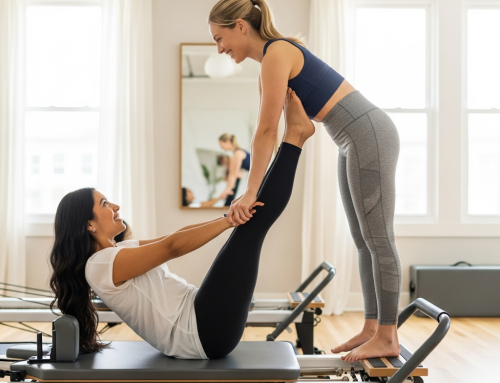
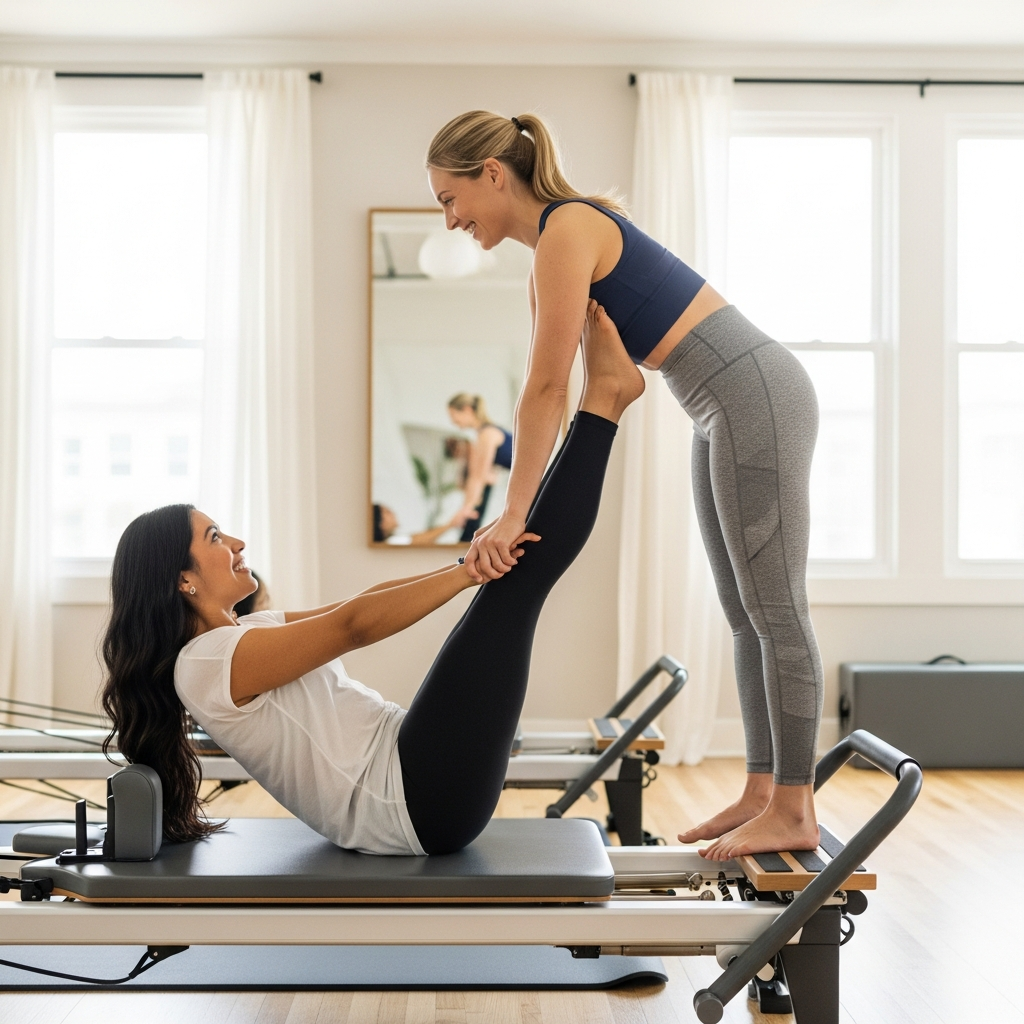
If you’ve peeked into a Pilates studio near Arlington and seen those strange bed-like contraptions on wheels and springs… yeah, those are Reformers. They look like something out of a medieval torture chamber, which is probably why some people walk right back out.
Here’s what’s actually happening on that machine. The spring resistance creates what instructors call “eccentric loading” – meaning your muscles have to work just as hard to lengthen as they do to contract. A bicep curl at the gym is mostly concentric (shortening) work. Reformer springs add resistance in both directions. The result? Muscles that learn to be strong *and* flexible, not just strong. This is a big part of why Pilates practitioners tend to have that long, lean look rather than the dense bulk you might see from heavy lifting.
Mat classes work on the same principles without the equipment – and honestly, they can be harder in some ways, because you’re relying entirely on your own body’s resistance.
The Mind-Muscle Connection (No, Really)
This phrase gets thrown around at regular gyms too, but Pilates takes it to a different level entirely. A standard gym workout can be done on autopilot – throw on headphones, zone out, count reps. That’s fine! Nothing wrong with that.
Pilates kind of won’t let you do that. Classes are structured so that you’re constantly receiving cues about *how* your body is positioned – are your ribs flaring? Is that shoulder creeping up toward your ear? Is the movement coming from your hip flexors when it should be coming from your glutes? This requires a level of focused attention that feels almost mentally exhausting when you first start. Actually, that reminds me – a lot of new Pilates students say they sleep better in the early weeks, and it might just be because their brain is working overtime learning new movement patterns.
What This Means for Your Body Over Time
The cumulative effect of all this intentional, detail-oriented work is different from what you get with conventional fitness. You’re essentially reprogramming movement patterns – training your body to move more efficiently in everything you do, not just during class. That’s why physical therapists recommend it so often for people recovering from injuries, and why so many athletes use it as a complement to their sport. The goal isn’t just fitness in the studio. It’s a body that functions better everywhere else too.
What to Actually Look For When Choosing a Studio
Here’s something most people don’t realize when they’re Googling studios in the Arlington area – not all Pilates classes are created equal, and the difference between a mediocre experience and a genuinely transformative one often comes down to a few very specific details.
First, ask about instructor certification. There are two main tracks: STOTT, BASI, or Balanced Body certified instructors have typically completed 450-600 hours of training. Compare that to someone who did a weekend workshop and slapped “Pilates instructor” on their bio. You’d never let someone with a weekend certification operate on your knee – this matters too. Ask directly: “What certification do you hold, and how many hours of training did it require?” A good instructor will love that question.
Also look at class sizes. Anything over 10-12 people in a reformer class and you’re essentially paying boutique prices for gym-style attention. The magic of Pilates is in the corrections and adjustments. If an instructor can’t watch your spine during a footwork series, you’re missing the point.
How to Prep for Your First Class (Without Embarrassing Yourself)
Wear fitted clothing – and I mean this genuinely, not just as a throwaway tip. Loose gym shorts get caught in the reformer carriage. Leggings or fitted shorts and a tucked-in top let an instructor actually see your alignment. This is one of those things nobody tells first-timers and then they’re fumbling with their shirt during the hundred. Not ideal.
Show up 15 minutes early to your first session. Tell the instructor about any injuries, even old ones. That old shoulder thing from 2019? Mention it. A skilled Pilates instructor can modify almost anything, but only if they know it exists.
Don’t eat a heavy meal beforehand. Unlike a gym session where you might power through some discomfort, Pilates involves compression, rotation, and deep core engagement – none of which are friendly toward a recent burrito.
Making It Work Alongside a Weight Loss Program
This is where it gets interesting, especially if you’re working with a medical weight loss program. Pilates isn’t going to torch 800 calories in a single session – let’s be honest about that. But it does something that straight cardio often doesn’t: it rebuilds your relationship with your body.
Here’s what that actually means in practice. When you’re losing weight medically – whether through medication, structured nutrition plans, or both – your body composition is shifting. Pilates helps you maintain and develop lean muscle tissue during that process, which matters enormously for your long-term metabolic health. It’s the difference between becoming lighter and becoming *stronger* and lighter.
Consider pairing two or three Pilates sessions per week with whatever cardio you’re already doing. The Pilates handles your core stability, posture, and muscular endurance. The cardio handles your cardiovascular health and calorie burn. They don’t compete – they complement each other in a way that’s actually kind of elegant.
The Arlington-Area Advantage You Should Use
One thing that’s genuinely useful about the Pilates scene around Arlington is the variety. You’ve got everything from clinical-style rehabilitation studios near the medical corridors to sleek boutique reformer studios, to smaller mat-focused spaces that are significantly more affordable.
If you’re brand new or recovering from injury, start with a studio that has a clinical or therapeutic bent – instructors there tend to be more conservative and careful, which is exactly what you want. If you’ve got a baseline of body awareness and you’re looking for more intensity, a boutique reformer class will challenge you in ways you probably haven’t expected.
Many studios in the area also offer introductory packages – sometimes three classes for a significantly reduced rate. Use these strategically. Try two or three different studios before committing to a membership. The instructor relationship matters more than the decor or the equipment brand, and you won’t know if it’s the right fit until you’ve actually been in the room.
One Honest Thing About Consistency
Progress in Pilates is genuinely slow to feel, but fast to see – and that can be confusing. You might not feel dramatically different after two weeks. But someone who knew you before? They’ll notice how you’re standing differently. Stick with twice a week for six weeks before making any judgments about whether it’s working. That’s the real minimum for meaningful change.
The Learning Curve Is Real (And Nobody Talks About It Enough)
Here’s something most Pilates studios won’t put in their marketing materials: the first few classes are genuinely humbling. You’ll walk in thinking, “How hard can controlled movements on a mat be?” and then spend 45 minutes discovering muscles you didn’t know existed while the person next to you flows through everything effortlessly. That person has probably been coming for two years. Don’t compare yourself to them.
The solution isn’t to push harder – it’s actually the opposite. Slow down more than feels comfortable. Most beginners rush through movements to compensate for not quite understanding what they’re supposed to feel. Ask your instructor after class to spend two minutes showing you one thing you struggled with. Good Pilates teachers near Arlington tend to be genuinely invested in their students, and that kind of one-on-one attention outside of class time? Worth its weight in gold.
Your Brain Gets Tired Before Your Body Does
This trips people up constantly. Gym workouts are relatively automatic – you know how to run, you know how to lift. Pilates requires you to think about what your ribcage is doing while simultaneously monitoring your breath, your hip position, and whether your shoulders are creeping toward your ears. It’s cognitively exhausting in a way that a spin class simply isn’t.
Some people quit during this phase because they feel like they’re failing. They’re not. They’re just learning a new language.
Actually, that’s not a bad way to think about it. The first weeks of Pilates are like learning Spanish – everything feels slow and clunky, you have to consciously translate every movement, and it feels nothing like fluency. Then one day, something clicks. The movements start to feel natural rather than assembled from instructions. That shift usually happens somewhere between weeks four and eight, which is – not coincidentally – right around when a lot of people give up.
If you can get to week six, you’ll probably stay forever.
Finding Classes That Fit Your Schedule (And Your Body)
Arlington has a solid range of Pilates options, but the scheduling reality is that popular class times fill up fast. The 6am and 6pm slots especially. If you work a traditional schedule and you’re not booking a week ahead, you’ll find yourself constantly frustrated and ultimately inconsistent.
The solution here is practical: treat your Pilates class like a medical appointment. Book it, put it in your calendar with a reminder, and don’t move it unless something genuinely urgent comes up. Studios with waitlists are actually a good sign – it means the community is active and the instruction is worth showing up for. Get on those waitlists.
For people managing injuries or chronic pain – and honestly, that’s a lot of us – the challenge is communicating what you’re dealing with before class, not during. Instructors can offer modifications, but only if they know what’s going on. Don’t suffer through something that hurts because you didn’t want to seem like a problem. A quick email or arriving five minutes early to mention a bad knee changes everything.
The Comparison Trap Is Everywhere
Unlike the gym where everyone’s in their own world with headphones on, Pilates classes have a visibility problem. You can see everyone. They can see you. And reformer classes in particular can feel like performing in a glass box.
This is genuinely uncomfortable for a lot of new students, and “just don’t compare yourself” is unhelpful advice. So here’s something more concrete: pick a focal point and keep returning to it during class. Practically speaking, focusing on a fixed point on the ceiling or wall does two things – it helps your form, and it stops your eyes from wandering to what everyone else is doing. Most studios also encourage students to close their eyes during certain exercises, which is worth taking them up on.
When Progress Stalls
You’ll have a stretch of classes where nothing seems to be improving. Everything feels just as hard as it did three weeks ago. This is normal and it’s also when most people secretly start wondering if the gym wasn’t so bad after all.
The honest answer is that progress in Pilates isn’t linear – it’s layered. You’re not just getting stronger, you’re rewiring movement patterns that took decades to develop. Sometimes the plateau you’re feeling is actually your nervous system catching up to your muscles.
Adding one private session during a plateau can break through it faster than anything else. It’s worth the investment every few months.
What to Actually Expect When You Start
Here’s something most fitness studios won’t tell you upfront: the first few Pilates sessions might feel… underwhelming. Or overwhelming. Sometimes both at once, weirdly enough.
You’ll probably spend a good chunk of your early classes just learning *how* to breathe correctly – and yes, that sounds absurdly simple, but the specific breathing patterns in Pilates are genuinely different from what you’re used to. You might feel slightly awkward, a little lost, maybe even wonder if you’re in the right place. That’s completely normal. It doesn’t mean Pilates isn’t for you. It just means you’re learning something new, which always feels clunky at first.
The other thing that catches people off guard? Soreness in places they didn’t know existed. That deep burn in your inner thighs, the weird ache along your spine, the realization that you apparently have a pelvic floor… all of this is your body waking up muscles that a standard gym routine simply doesn’t reach. Consider it a good sign.
Realistic Timelines (No Sugarcoating)
Let’s be honest about the numbers, because the fitness world is full of “six weeks to a new you!” promises that set people up for disappointment.
Most people notice improved posture and body awareness within three to four weeks of consistent practice – and by consistent, we mean two or three sessions per week. That’s actually meaningful progress, even if it doesn’t feel dramatic. You’ll start catching yourself sitting differently. Standing taller. Noticing when your shoulders have crept up around your ears.
Visible physical changes – the stuff you’d notice in the mirror – typically take longer. Eight to twelve weeks is a more honest window, assuming you’re attending regularly and not counteracting everything with other lifestyle factors. Some people see shifts sooner, some later. Bodies are frustratingly individual that way.
Strength improvements often surprise people though. Because Pilates works stabilizer muscles so specifically, you might notice functional differences faster than expected – things like getting up from the floor more easily, carrying groceries without the usual back twinge, or making it through a long workday without that familiar afternoon slump. These wins don’t show up on a scale, but they’re real.
The First Few Classes – A Heads Up
If you’re trying a mat class first (which is a perfectly reasonable place to start), expect to feel like everyone else knows a secret language. They kind of do. Give it three or four classes before you judge whether it’s clicking for you.
Reformer classes – the ones with the sliding carriage and all the springs and straps – add another layer. The equipment looks vaguely medieval the first time you see it, but instructors at quality Arlington studios will walk you through everything. Don’t be afraid to say “I have no idea what I’m doing.” They hear it constantly. They’re not judging you.
Actually, that reminds me of something worth mentioning – smaller class sizes, which are common at boutique studios compared to big gyms, mean instructors can actually *see* you. That’s both good and slightly humbling. You can’t just blend into the back row and approximate the movements. But that attention is also what makes Pilates effective so much faster than going it alone.
Setting Yourself Up for Progress
A few things that genuinely help in those early weeks: wearing fitted clothing so an instructor can see your alignment, showing up a few minutes early to introduce yourself and mention any injuries or areas of concern, and – this is underrated – not skipping the modifications. A modified version done correctly will always beat a “full” version done wrong.
If you’re combining Pilates with a broader weight management program, communicate that with both your medical team and your instructor. The two approaches can work really well together, but coordination matters.
And please don’t compare yourself to the person next to you who’s been coming for two years. That way lies madness.
The Bottom Line on Next Steps
Finding the right studio honestly matters more than people realize – the vibe, the instructors, the class sizes, the scheduling. Most studios in the Arlington area offer introductory packages or trial classes, which is worth taking advantage of before committing to a membership. Try a couple of places. Pay attention to how you feel walking out, not just during. That post-class feeling – that particular kind of tired and oddly centered – tells you a lot.
So here’s what it really comes down to – Pilates and your typical gym session are just built from different blueprints. One throws a bunch of equipment at you and says “figure it out.” The other asks you to slow down, pay attention, and actually *listen* to what your body is trying to tell you. And honestly? For a lot of people – especially those dealing with stubborn weight, old injuries, or that general feeling of being disconnected from their own bodies – that difference is everything.
The Arlington area has some genuinely wonderful options for this kind of mindful, intentional movement. And it’s worth knowing that what happens in a Pilates class isn’t just about burning calories or building a six-pack (though both can absolutely happen). It’s about retraining the way you move through your entire day. The way you sit at your desk. The way you carry groceries. The way you get up off the floor without that little groan you’ve been pretending not to make. You know the one.
This Isn’t About Abandoning the Gym
If you love your gym, keep going. Seriously. The goal isn’t to swap one thing for another – it’s to understand what each tool in your wellness toolkit actually *does*. A hammer and a screwdriver are both useful. You just need to know which one to reach for.
What Pilates offers – the core stability, the postural work, the breath control, the slow-twitch muscle engagement – genuinely complements more intense training. A lot of people find that adding even one or two Pilates sessions a week makes their other workouts feel better. Cleaner. Less injury-prone. Like their body finally got the instruction manual it was missing.
You Don’t Have to Figure This Out Alone
Here’s the thing that gets lost in all the fitness content online: most of us aren’t struggling because we lack willpower or information. We’re struggling because we don’t have the right support structure around us. The accountability. The personalized guidance. Someone who actually looks at *you* – not a generic program – and helps map out what’s going to work for your body, your goals, your life.
That’s exactly what we’re here for.
If you’ve been curious about how Pilates might fit into your weight loss or wellness plan – or if you’re just feeling stuck and aren’t sure what your next step should even be – we’d genuinely love to talk. Not a hard sell, not a scripted consultation. Just a real conversation about where you are and where you want to go.
Reach out to our team whenever you’re ready. There’s no pressure and no perfect moment you need to wait for. We work with people at all different starting points, and we’ve seen firsthand how much can shift when someone finally gets the right kind of support around them.
You’ve been doing a lot of figuring-it-out-alone already. Maybe it’s time to let someone help.