7 Things to Know Before Your First Pilates Class in Oak Cliff
Picture this: You’re standing outside that sleek Pilates studio on Bishop Street, clutching your brand-new yoga mat (because you weren’t sure if there was a difference), and suddenly your confidence just… evaporates. Through the floor-to-ceiling windows, you see impossibly graceful people doing things with their bodies that look like a cross between ballet and gentle torture. Your inner voice starts up: *What if I can’t do any of this? What if everyone’s been doing Pilates since they were twelve? What if I fall off that weird reformer machine?*
Sound familiar?
Here’s the thing – and I mean this with all the love in the world – that intimidation you’re feeling? It’s completely normal, but it’s also completely unnecessary. Every single person in that class was once exactly where you are right now, staring at those intimidating contraptions and wondering if they’d accidentally signed up for some sort of medieval fitness torture chamber.
I’ve been working with people starting their wellness journeys for years, and I can’t tell you how many times I’ve watched someone transform from that nervous person outside the studio into someone who genuinely looks forward to their Pilates sessions. It’s not just about the physical changes (though those are pretty amazing). It’s about discovering this thing your body can do that feels both challenging and oddly soothing at the same time.
But let’s be real for a second – walking into your first Pilates class without knowing what to expect is kind of like showing up to a dinner party where everyone’s speaking a language you don’t quite understand yet. You’ll catch some words here and there, but you’re mostly just trying not to embarrass yourself while figuring out what the heck a “hundred” is and why everyone seems so excited about their “powerhouse.”
The Oak Cliff Pilates scene has this wonderful, welcoming energy that’s different from some of those intimidating fitness spaces you might have encountered before. Maybe it’s something about our neighborhood – we’re used to embracing newcomers and helping people find their groove. But even in the most welcoming environment, walking in prepared makes all the difference between feeling like you belong and feeling like you’re drowning in a sea of unfamiliar terminology and equipment.
That’s where this comes in. Think of what you’re about to read as your friendly insider’s guide – the conversation I wish I could have with every first-timer before they walk through those studio doors. We’re going to talk about the practical stuff that no one tells you (like what to wear when you have no idea what you’ll be doing with your body), the mental preparation that actually matters, and those little details that can make or break your first experience.
You know what’s interesting? Most people think Pilates is either going to be super easy (it’s just stretching, right?) or impossibly difficult (only for dancers and people who can touch their toes to their nose). The reality sits somewhere in the middle – it’s accessible enough that you can start wherever you are, but challenging enough that you’ll feel accomplished when you nail that first roll-up or finally understand what your instructor means when they talk about “finding your neutral spine.”
We’ll walk through everything from decoding the class schedule (because apparently there’s a difference between Mat and Reformer, and someone should probably explain that) to understanding what your body might feel like the next day (spoiler: different than after other workouts, but in a good way). We’ll talk about what questions to ask, what to expect from your instructor, and how to set yourself up for success without putting pressure on yourself to be perfect.
Because here’s what I really want you to know before we get into all the practical details: Your first Pilates class isn’t about proving anything to anyone. It’s not about keeping up or looking like you know what you’re doing. It’s about showing up for yourself and taking the first step toward something that could genuinely change how you feel in your own body.
So take a deep breath. You’ve got this. And by the time you finish reading, you’ll walk into that studio feeling prepared, confident, and maybe even a little excited about what you’re about to discover.
What Actually IS Pilates? (And Why Everyone Gets It Wrong)
Okay, let’s clear something up right away – Pilates isn’t just fancy stretching for people who wear $200 yoga pants. Though… some of us do wear those pants, and honestly, they’re pretty great.
Joseph Pilates created this system back in the 1920s, and he called it “Contrology.” Think of it as strength training disguised as graceful movement. You’re not just lying on a mat doing crunches (thank goodness) – you’re teaching your entire body to work like a well-orchestrated symphony instead of a garage band where everyone’s playing different songs.
The weird thing? It looks deceptively easy. You’ll watch someone doing “The Hundred” and think, “Pfft, I could totally do that.” That’s like watching a professional chef make an omelet and assuming you could do it blindfolded. The devil’s in the details, and Pilates has about a million tiny details.
Your Core Isn’t What You Think It Is
Here’s where things get interesting – and slightly confusing. When most people hear “core,” they picture six-pack abs. But your core is more like the foundation of a house than the pretty shutters on the front.
We’re talking about your deep abdominal muscles (the ones you can’t see in Instagram photos), your pelvic floor, your diaphragm, and those little muscles that run along your spine. It’s like having an internal corset that supports everything you do – from picking up your coffee to… well, literally everything.
The tricky part? You can’t just flex these muscles like you would your biceps. They work differently. It’s more like learning to breathe properly while simultaneously engaging muscles you didn’t know existed. Fun, right?
The Mind-Body Connection Thing (Yes, It’s Real)
Look, I used to roll my eyes when instructors talked about “mind-body connection.” It sounded like wellness industry nonsense. But here’s the thing – Pilates forces you to think about every single movement.
You can’t zone out and go through the motions like you might on a treadmill. Every exercise requires you to coordinate breathing, alignment, and muscle engagement simultaneously. It’s like patting your head while rubbing your stomach… while standing on one foot… while reciting the alphabet backwards.
This mental focus is actually what makes Pilates so effective for weight loss and overall wellness. When you’re fully present in your body, you start noticing things – how you move through daily life, where you hold tension, what feels off. It’s weirdly enlightening.
Equipment vs. Mat Work (And Why Both Matter)
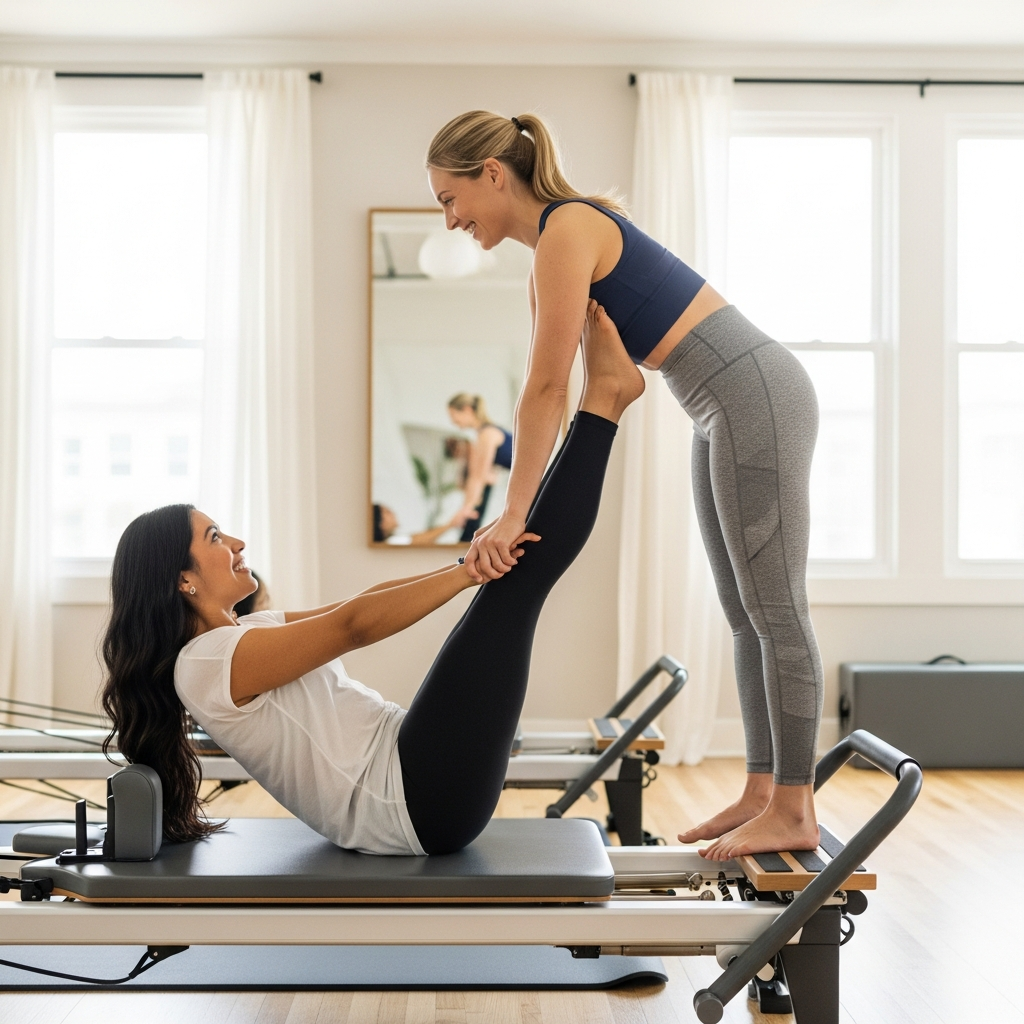
You’ve probably seen those medieval torture device-looking machines called Reformers. Don’t panic – they’re actually amazing once you understand them. The springs and pulleys provide resistance and assistance, kind of like having a really smart workout partner who knows exactly how much help to give you.
Mat work, on the other hand, is you versus gravity. No springs to help, no straps to guide you – just your body learning to support itself properly. It’s harder than it looks (sensing a theme here?).
In Oak Cliff studios, you’ll likely encounter both. Mat classes are perfect for beginners because you’re learning fundamental movements without the complexity of equipment. Think of it as learning to walk before you run… or in this case, learning to engage your powerhouse before you navigate a Reformer.
Why Your First Class Will Feel Weird
Let’s be honest – your first Pilates class is going to feel strange. You’ll be asked to move in ways that don’t feel natural initially. Your instructor might tell you to “lengthen your spine while drawing your shoulder blades down and back” while you’re trying not to fall over.
It’s like learning a new language, but with your body. Some movements will click immediately, others will make you question your coordination… and that’s completely normal. Actually, that’s the point.
The beauty is that every body is different. What feels impossible today might feel natural next week. And unlike other workouts where you might push through pain or discomfort, Pilates teaches you to listen to your body – which, honestly, is a skill we could all use more of these days.
What to Actually Wear (And Why Those $80 Leggings Aren’t Necessary)
Here’s the thing about Pilates gear – you probably already own everything you need. Those form-fitting leggings everyone talks about? They’re nice, but honestly, any stretchy pants that won’t ride up during leg circles will work perfectly fine. The key is avoiding anything too loose that’ll flop around when you’re inverted… because yes, you’ll probably end up upside down at some point.
Skip the baggy t-shirts though. I learned this the hard way when my oversized tee kept sliding over my head during roll-ups. Fitted tops are your friend here – tank tops, sports bras, or snug tees work great. And socks? Ditch them. Most Oak Cliff studios prefer bare feet for better grip on the equipment, though some offer those little grippy socks if you’re not ready to go full barefoot warrior.
The Real Deal About That First-Day Soreness
Let’s be honest – you’re probably going to feel muscles you forgot existed. Pilates has this sneaky way of finding every weak spot in your body and giving it a gentle (okay, sometimes not-so-gentle) wake-up call. That burning sensation in your deep abdominal muscles during those seemingly simple exercises? That’s completely normal.
The soreness usually peaks around day two or three after your first class. Your inner thighs might protest when you get out of bed, and don’t be surprised if your shoulders feel like you’ve been carrying groceries for hours. This isn’t a sign you overdid it – it’s just your body saying “Hey, we’re actually using these muscles properly now!”
Pro tip: gentle movement helps more than staying completely still. A short walk around the Bishop Arts District the day after your class can actually help work out some of that initial stiffness.
How to Decode Pilates Instructor Language
Pilates teachers speak in a special code that can sound like a foreign language at first. When they say “find your powerhouse,” they’re talking about that area from your ribcage to your hip bones – basically your entire core. “Neutral pelvis” doesn’t mean you need to lie there like a board; it’s that sweet spot where your lower back has its natural curve.
And here’s something no one tells you – when the instructor says “just a small movement,” they really mean it. I spent my first few classes making these giant, dramatic movements while everyone else was doing tiny, controlled motions that looked almost… boring? But those small movements are where the magic happens.
“Breathe into your back” sounds impossible until you actually feel it happen. It’s not about gulping air – it’s more like gently expanding your ribcage in all directions.
The Equipment Intimidation Factor (And How to Handle It)
That reformer machine might look like medieval torture equipment, but I promise it’s not plotting against you. Those springs and pulleys are actually there to help support your movements, not make them harder. Well… most of the time.
Don’t stress about adjusting the springs yourself on your first visit – your instructor will handle all that. Each person needs different spring tension based on their strength and the specific exercise, so there’s definitely a learning curve there.
The Cadillac (yes, that’s really what it’s called) looks even more intimidating with all its bars and springs, but it’s actually incredibly supportive. Think of it as Pilates training wheels – it helps you find proper form before you progress to more challenging variations.
Managing Expectations vs. Reality
Here’s what I wish someone had told me: you’re not going to nail everything in your first class. Actually, you’re probably not going to nail everything in your first ten classes, and that’s perfectly fine. Pilates is less like learning to ride a bike and more like learning to play piano – it takes time to develop that mind-body connection.
You might feel uncoordinated at first, especially when trying to coordinate breathing with movement while maintaining proper form. Some days your balance will be spot-on, other days you’ll wobble like a newborn giraffe. Both scenarios are completely normal.
The goal isn’t perfection – it’s consistency and gradual improvement. Those subtle adjustments your instructor makes to your positioning? They’re gold. Pay attention to how those small tweaks completely change how an exercise feels. That’s your body learning to move more efficiently, and it’s honestly pretty amazing once you start noticing the differences.
You’re Going to Feel Awkward (And That’s Completely Normal)
Let’s just get this out there – your first Pilates class is going to feel weird. You’ll probably spend half the time wondering if you’re doing anything right, and the other half trying not to topple over during what looks like the world’s most graceful leg circle.
Here’s the thing though… everyone in that room has been exactly where you are. That person flowing through movements like water? She once fell off the reformer trying to do footwork. The guy with perfect form spent his first class gripping the straps like his life depended on it.
The solution isn’t to wait until you’re “ready” – it’s to embrace the awkwardness. Show up early and tell your instructor it’s your first time. Most Oak Cliff studios are incredibly welcoming, and your teacher will keep an eye on you without making you feel singled out. Actually, that reminds me – don’t hide in the back corner. Get somewhere you can see the instructor clearly.
Your Core Is Weaker Than You Think (Even If You Work Out)
I see this all the time with new clients who come from running or weightlifting backgrounds. They walk in confident, thinking Pilates will be a nice, easy recovery workout. Then we hit the first teaser prep and… reality check.
Pilates targets deep stabilizing muscles that regular gym workouts often miss entirely. You might be able to deadlift your bodyweight, but holding your legs at a 45-degree angle while articulating through your spine? That’s a whole different conversation your muscles haven’t had yet.
Don’t let this discourage you – it’s actually exciting. You’re about to discover muscles you forgot you had. Start with modified versions of everything. Use props. Rest when you need to. Your core will catch up faster than you think, but it needs time to learn this new language of movement.
The Mind-Body Connection Thing Isn’t Just Yoga Speak
Before my first class, I rolled my eyes every time someone mentioned “mind-body connection.” It sounded like wellness industry nonsense. But here’s what I learned – in Pilates, your brain literally has to work differently.
You’re not just moving your leg… you’re initiating from your core, maintaining neutral spine, breathing in a specific pattern, AND keeping your shoulders away from your ears. It’s like learning to juggle while riding a unicycle. Your brain will feel tired in a way that has nothing to do with physical exertion.
This mental fatigue is real, and it’s why many people leave their first class feeling surprisingly wiped out. Give yourself permission to focus on just one or two cues at a time. If the instructor gives you five things to think about, pick the two that feel most important and let the others go for now.
You’ll Compare Yourself to Everyone (But You Really Shouldn’t)
That woman next to you making it look effortless? She might be dealing with chronic back pain and has been working on basic movements for months. The person flowing through advanced exercises could be a former dancer who’s been practicing for years.
Pilates attracts people from every fitness background and body type imaginable. Some folks are there for injury recovery, others for athletic performance, some just want to feel stronger in their daily life. You can’t tell someone’s story by watching them move – and comparing your day one to their day 365 will only steal your joy.
Here’s a trick that actually works: Instead of watching others, get curious about your own body. Notice how your right side feels different from your left. Pay attention to which movements feel surprisingly challenging and which ones click right away. Make it about exploration, not performance.
The Equipment Might Intimidate You at First
If you’re starting on the reformer, those springs and pulleys can look like medieval torture devices. Don’t worry – your instructor will explain everything, and the machine is actually designed to help you, not hinder you.
Start by asking about the spring settings. Contrary to what you might think, more springs don’t always mean harder – sometimes they provide the support you need to find proper alignment. Don’t be shy about asking for adjustments throughout class.
And honestly? If something feels genuinely uncomfortable (not challenging, but actually wrong), speak up. Good instructors want you to feel safe and successful, not like you’re fighting the equipment.
The bottom line is this: Pilates has a learning curve, but it’s not a steep mountain – it’s more like learning to dance with your own body. Give yourself time, stay curious, and remember that everyone started exactly where you are now.
What to Expect After Your First Class (Spoiler: You’ll Probably Be Sore)
Let’s be real here – after your first Pilates class, you’re going to discover muscles you forgot existed. That weird ache between your shoulder blades? Totally normal. The way your abs protest when you laugh at your friend’s joke the next day? Welcome to the club.
Most people walk out of their first session feeling pretty good… until about 24 hours later when the delayed onset muscle soreness kicks in. It’s not that you overdid it (well, maybe you did a little), but Pilates has this sneaky way of working deep stabilizing muscles that don’t get much attention in regular daily life. Think of it like this – you’ve been using the highway muscles for years, and suddenly you’re asking all these little side streets to handle traffic too.
The soreness typically peaks around day two and then starts to fade. By the end of your first week, you’ll notice you’re moving a bit differently – maybe standing a little taller, or catching yourself engaging your core when you lift your grocery bags.
Your First Month: Building the Foundation
Here’s where I’m going to be the friend who tells you what you need to hear, not what you want to hear. You’re not going to have a completely transformed body after four weeks. I know, I know – we’ve all seen those dramatic before-and-after photos on social media. But real, sustainable change? That takes time.
What you *will* notice in your first month is improved awareness. You’ll start to understand what your instructor means when they say “find your neutral spine” (which probably sounded like gibberish in class one). Your balance will get better – you might notice you’re steadier when putting on your shoes or reaching for something on a high shelf.
Aim for 2-3 classes per week during this foundation period. I’ve seen too many enthusiastic beginners burn out by trying to go every single day. Your body needs recovery time to adapt and strengthen. Plus, let’s be honest – your schedule probably can’t handle daily Pilates on top of everything else you’ve got going on.
Some weeks will feel amazing… others, not so much. That’s completely normal. Your energy levels, stress, sleep, and even what you ate for lunch can affect how a class feels.
The 3-Month Mark: Where Things Get Interesting
This is usually when people start to feel like they’re “getting it.” The exercises that seemed impossible in month one become your warm-up. You’ll probably find yourself automatically engaging your core during everyday activities – which sounds boring but is actually pretty revolutionary.
Your posture will likely improve enough that people start commenting on it. Your back might stop aching after long days at the computer. You might sleep better, feel more balanced (literally and figuratively), and notice that climbing stairs doesn’t leave you winded.
But here’s the thing about the three-month mark – it’s also when some people hit a plateau and get discouraged. The dramatic initial improvements level off, and progress becomes more subtle. This is actually when the real magic happens, but it requires patience.
Building Your Practice Long-Term
After six months of consistent practice, Pilates stops being something you “do” and starts being part of who you are. You’ll probably have developed preferences for certain instructors, favorite exercises, and a pretty good sense of what your body needs on any given day.
The students I see stick with it long-term are the ones who found a way to make it work with their actual life, not their ideal life. Maybe that means morning classes because evenings are chaos with kids’ activities. Maybe it’s virtual sessions because Oak Cliff traffic makes evening classes stressful. Or maybe it’s Sunday workshops because that’s your dedicated self-care time.
Setting Realistic Expectations
Look, I’m going to level with you – Pilates isn’t going to solve all your problems or give you a completely new body in six weeks. What it will do is help you feel more connected to the body you have right now. It’ll improve your posture, reduce back pain, increase flexibility, and build functional strength that makes everyday life easier.
The people who love Pilates long-term are usually those who approached it with curiosity rather than desperation. They came in wanting to feel better, move better, and maybe stand a little taller – both physically and metaphorically. And you know what? That’s exactly what they got.
You’ve Got This – And We’ve Got Your Back
Look, I get it. Walking into that first Pilates studio can feel a bit like stepping into someone else’s world – all those reformer machines that look vaguely like medieval torture devices, everyone else seeming to know exactly what they’re doing while you’re still figuring out which end is up.
But here’s the thing… everyone in that room was exactly where you are right now at some point. That instructor who makes those impossible moves look effortless? She probably wobbled through her first hundred just like you will. The person next to you who’s flowing through movements like water? They’ve been there too.
What I love about starting Pilates – especially here in Oak Cliff where our community actually feels like, well, a community – is that it’s not about being perfect from day one. It’s about showing up. It’s about listening to your body, honoring where you are today, and trusting the process.
And honestly? Your body is going to surprise you. Maybe not in that first class (though sometimes it does), but soon. You’ll notice you’re standing a little taller at the coffee shop. Your back won’t ache after sitting at your desk all day. You’ll feel… steadier. More connected to yourself.
The beautiful thing about Pilates is that it meets you where you are. Whether you’re dealing with chronic pain, recovering from an injury, or just tired of feeling disconnected from your body, those precise, controlled movements start working their magic pretty quickly. It’s like having a conversation with muscles you forgot you had.
Sure, you might feel a little sore after that first class – the good kind of sore that reminds you that you did something wonderful for yourself. And yes, you might mix up your “inhale on the twist” with your “exhale on the extension” a few times. That’s completely normal. Actually, it’s part of the charm.
What matters most is that you’re taking this step. You’re prioritizing your health, your strength, your well-being. In our busy world, that’s not always easy to do. But you’re doing it anyway, and that tells me everything I need to know about your commitment to feeling better.
Ready to Take the Next Step?
If you’re feeling excited about starting Pilates but still have questions about how it might fit into your wellness goals – especially if weight management is part of your picture – I’d love to chat with you. Sometimes it helps to talk through your specific needs, concerns, or health challenges with someone who understands both the fitness side and the medical side of things.
Whether you’re wondering how Pilates might complement your weight loss efforts, curious about modifications for specific health conditions, or just want to make sure you’re setting yourself up for success, please don’t hesitate to reach out. We’re here to support you, not to sell you anything – just to help you feel confident and informed as you take this wonderful step forward.
Your body has been waiting for this. Let’s make it happen.