Is Reformer Pilates Hard for Beginners? A Deep Dive into Your First Step to Fitness
The first step is always the hardest, they say, and this rings true when you venture into a fitness journey. However, that first step could also potentially be the most rewarding. If you’ve ever contemplated trying Pilates, specifically reformer Pilates, but have been deterred by the daunting question, “Is reformer Pilates hard for beginners?” then this blog post is designed specifically for you.
When it comes to Pilates, many tend to confuse the traditional mat Pilates with reformer Pilates. Mat Pilates is performed on the floor using a yoga mat and primarily recruits your body weight as resistance. On the other hand, reformer Pilates involves a special machine (reformer) equipped with springs, straps and pulleys to create resistance, thereby offering a more intensive workout. As you embark on this adventure of exploring reformer Pilates, understanding these subtle yet crucial differences can help set realistic expectations, making your journey less intimidating and more enjoyable.
In this comprehensive guide, we aim to break down the barriers of fear and misconception surrounding reformer Pilates for beginners. We intend to cover topics such as the fundamental principles of reformer Pilates, what a typical beginner’s class looks like, potential challenges you might face, and tips to overcome them. We will also delve into the benefits and outcomes you can expect from incorporating this unique form of exercise into your fitness routine.
Why is this important? Because embarking on a new fitness journey is not just about physical transformation; it’s also about mental preparation. By providing an in-depth understanding of what reformer Pilates entails for beginners, we hope to empower you with the knowledge and confidence to step onto that reformer machine without hesitation.
Reformer Pilates is often perceived as a challenging form of exercise due to its emphasis on precision, control, and specific breathing patterns. Furthermore, the unfamiliarity and complexity of the reformer machine might seem intimidating to beginners. However, like any other fitness regimen, it is vital to remember that everyone starts somewhere. Just as you wouldn’t expect to run a marathon without training, don’t assume that you’ll be able to execute advanced Pilates moves right away. Instead, appreciate the process of learning and gradually building your strength, flexibility and endurance.
We believe that every fitness journey should be a personal one, tailored to your unique body and needs. Reformer Pilates is no different. Although it might present initial challenges, with patience and persistence, it can be an incredibly rewarding addition to your health and fitness lifestyle.
So, are you ready to debunk the myth that reformer Pilates is too hard for beginners? Let’s dive deep into the world of reformer Pilates and unlock the power of this transformative exercise system together. Whether you’re a fitness enthusiast looking for a new challenge or a beginner searching for a holistic approach to health and wellbeing, this guide promises to provide valuable insights and practical tips to help you embark on your reformer Pilates journey with confidence and clarity.
Reformer Pilates is a type of exercise that focuses on the overall strength, flexibility, and balance of the body. Named after its creator, Joseph Pilates, the reformer is an intricate machine with a flat platform that can be moved back and forth along a carriage. It uses springs for resistance along with other components like straps and a foot bar to create a versatile workout. Invented in the 1920s to rehabilitate injured war veterans, Pilates has become a mainstay fitness routine for those looking to strengthen their core and improve their posture.
The question often arises, “Is reformer Pilates hard for beginners?” The answer isn’t straightforward as it depends on various factors such as an individual’s fitness level, familiarity with Pilates exercises, and understanding of the fundamental principles of Pilates. Before exploring this question further, let’s delve into what Pilates is all about, its principles, benefits, and how the reformer fits into this framework.
Pilates is a low-impact form of exercise designed to strengthen muscles while improving postural alignment and flexibility. It focuses on controlled movements primarily aimed at strengthening the core, although the benefits extend beyond the core to the whole body. A crucial aspect of Pilates is its emphasis on mind-body connection where one must stay fully aware of how the body moves during each exercise. The focus is not on repetition or exertion, but on precision and control.
Pilates operates on six basic principles: Centering, Control, Flow, Breath, Precision, and Concentration. Centering refers to bringing the focus to the center of the body (the powerhouse area which spans from the lower ribs to pubic bone) from which all movements originate. Control speaks about maintaining muscular control throughout movements, eliminating unnecessary tension. Flow emphasizes smooth, continuous movements rather than jerky or quick motions. Breath is central to Pilates – practitioners are taught to breathe fully and rhythmically, coordinating breath with movement. Precision is about being accurate with movements, focusing on quality rather than quantity. Lastly, Concentration is crucial as it is believed that the mind guides the body.
Reformer Pilates takes these principles and applies them in a unique way using the reformer machine. The reformer adds a level of resistance to the Pilates exercises that can be adjusted to suit the individual’s strength and skill level. This can make the workout more challenging, but also more effective in targeting specific muscle groups. The reformer can add an extra dimension to traditional Pilates exercises, especially for those who have mastered mat exercises and are looking for an added challenge or variety.
Now, is reformer Pilates hard for beginners? For anyone new to Pilates, it can indeed seem daunting. The reformer machine itself appears complex, and the precise movements may seem difficult to master at first. However, with proper guidance and gradual progression, beginners can certainly engage in reformer Pilates. In fact, some beginners might find that the reformer helps them better understand and perform the movements due to its structured nature. The key is to start slow, focusing on understanding and mastering the form and technique rather than rushing through exercises.
It is also important for beginners to remember that Pilates is not about competition or comparison. Each individual’s body is different and will move and progress at different rates. A good instructor will understand this and adjust exercises or resistance levels to suit each individual’s needs and abilities.
In conclusion, while reformer Pilates may present a new set of challenges for beginners, it’s not necessarily harder than mat Pilates. It’s just different. With patience, practice, and a focus on the principles of Pilates – Centering, Control, Flow, Breath, Precision, and Concentration – beginners can reap the benefits of a stronger core, increased flexibility and improved posture through reformer Pilates.
Beginning a new fitness journey can often feel intimidating, and if you’re considering trying out Reformer Pilates, you might be wondering if it’s too hard for beginners. Reformer Pilates, named after the specialized piece of equipment used during the workout, might seem daunting at first glance with its system of pulleys, straps, springs, and a carriage that moves back and forth. But don’t let this scare you away. With proper guidance and progression, Reformer Pilates can be a great addition to any fitness regimen, regardless of your level of experience.
Firstly, it’s important to understand the differences between Mat and Reformer Pilates. Mat Pilates is performed on a mat and primarily uses your body weight as resistance. It’s great for beginners because it introduces the basic movements and principles of Pilates such as core control, breath control, coordination, and balance.
On the other hand, Reformer Pilates takes place on the aforementioned machine. The reformer adds resistance to the Pilates exercises via the use of the springs which can be adjusted at different levels of difficulty. This makes Reformer Pilates adaptable to your fitness level and needs.
Now, let’s tackle the main question: Is Reformer Pilates hard for beginners?
Reformer Pilates does pose a challenge due to its complexity and the need for an understanding of its principles, but it isn’t inaccessible for beginners. Here’s a step-by-step guide on how beginners can approach Reformer Pilates
1. **Start with Mat Pilates**: Before jumping into a Reformer class, consider starting with Mat Pilates. This will help you become familiar with the basic Pilates exercises and principles. Once you have a good grasp of these, you can then apply them to the more advanced equipment like the reformer.
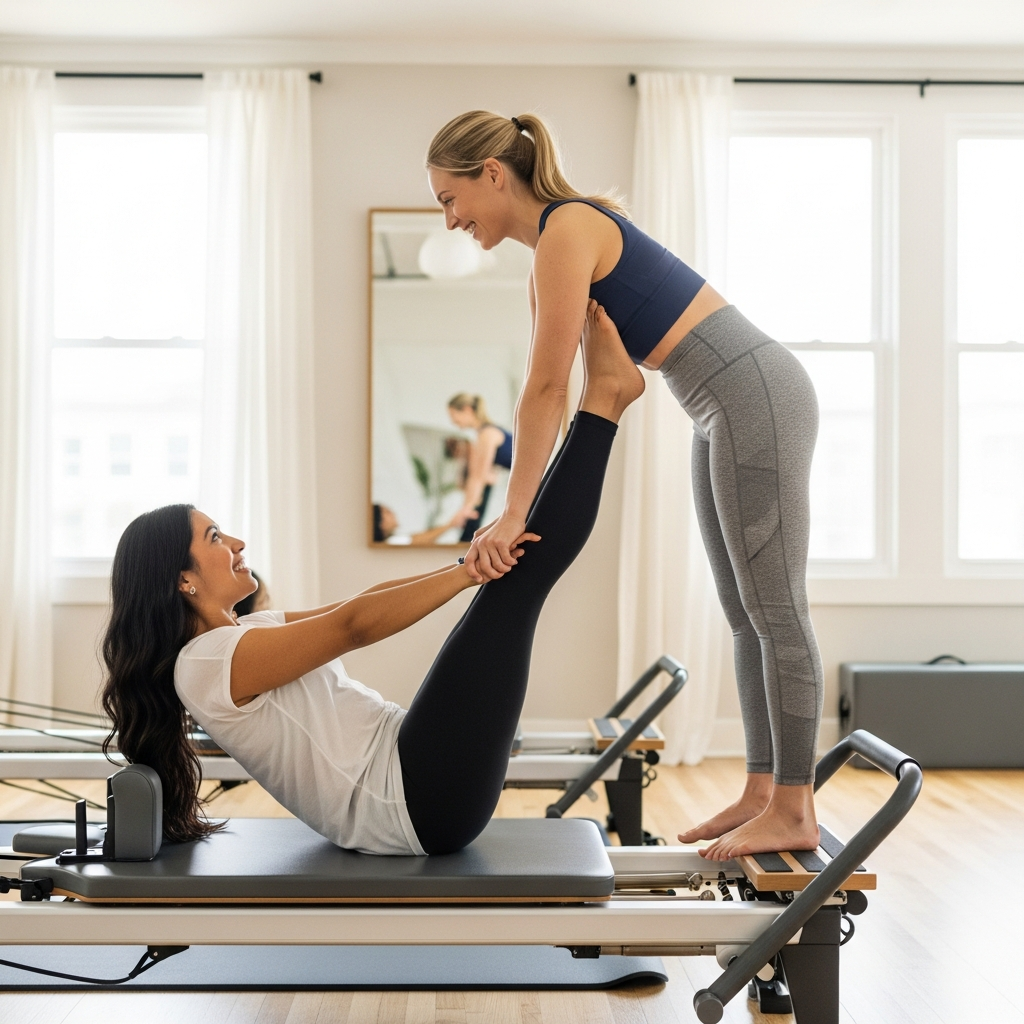
2. **Take a Beginner’s Class**: Many studios offer beginner’s classes where the pace is slower and the instructor takes time to explain the movements and the use of the machine. These classes provide a safe and supportive environment where you can learn the basics of using a reformer.
3. **Invest in Private Lessons**: If you’re still feeling unsure, consider investing in a few private lessons. A one-on-one session with an instructor will allow you to get personalized feedback and instructions. The instructor can also modify the exercises to suit your ability and help you understand how to adjust the machine to your comfort level.
4. **Listen to Your Body**: Pilates is all about control and precision, not speed or repetition. It’s more important to perform an exercise correctly than to do it quickly or repetitively. Therefore, listen to your body. If something doesn’t feel right, adjust the machine or ask your instructor for assistance.
5. **Patience and Persistence**: As with any new fitness routine, progress takes time. Don’t get discouraged if you find some exercises challenging at first. With consistent practice, you’ll improve your strength, flexibility, and understanding of the reformer.
6. **Regular Practice**: Consistency is key in Reformer Pilates. Try to attend classes regularly (2-3 times a week) to build strength and confidence on the reformer. Over time, you’ll find yourself mastering exercises that were once challenging.
In real-world scenarios, beginners often struggle with exercises that require coordination between the reformer and their own body movements. For example, the “Feet in Straps” exercise where you lie on your back with your feet in the reformer straps and perform leg circles or frog kicks can be tricky for beginners. However, with practice and guidance from your instructor, you’ll soon be executing these exercises with ease.
In conclusion, while Reformer Pilates might seem hard for beginners due to its unique equipment and emphasis on precision, it’s absolutely accessible with the right approach and mindset. Remember, everyone was a beginner at some point, so don’t be too hard on yourself. Embrace the challenge, and enjoy the journey of improving your strength, flexibility, and overall fitness with Reformer Pilates.
Conquering the Reformer: Pilates for Beginners
The journey towards mastering Pilates, particularly reformer Pilates, can be a challenging yet rewarding endeavour. This dynamic practice, which uses a unique piece of equipment known as the reformer, specializes in promoting strength, flexibility, and overall body awareness. Yet many beginners may find themselves questioning, “Is reformer Pilates hard?”
Challenges and Misconceptions in Reformer Pilates
The initial intimidation factor is often the first challenge that beginners face. The reformer, with its system of springs, straps, and pulleys, can appear complex and daunting. There’s a misconception that it’s a torture device or some sort of medieval rack, but that’s far from the truth. Not only is the reformer completely safe under proper supervision, but it’s also an incredibly versatile tool that facilitates a wide range of exercises.
Mat Pilates vs Reformer Pilates
Another common misconception is that mat Pilates and reformer Pilates are interchangeable. While they share similar principles – focus on core strength, concentration, control, precision, breath, and flow – the experience in execution differs significantly. Mat Pilates uses the body’s own resistance, whereas the reformer provides additional resistance from the springs, offering a more challenging and diverse workout.
Reformer Pilates is also often perceived as more difficult because it requires greater coordination and understanding of the equipment. However, this doesn’t mean it’s harder or easier than mat Pilates; they simply offer different types of challenges and benefits.
Solutions for Beginners in Reformer Pilates
Starting with a beginners’ class or a private session is the best way to familiarize yourself with the reformer. An experienced instructor will guide you through the equipment setup and basic exercises, ensuring you understand the correct form and technique. As you gain confidence and experience, you can gradually tackle more complex moves and configurations.
Don’t be afraid to ask questions or seek clarifications from your instructor. Remember, everyone starts somewhere, and there’s no shame in taking your time to get the hang of things.
Expert Tips for Successful Reformer Pilates Practice
Consistency is key: Like any new skill, practice makes perfect. Regular sessions will help you become more comfortable with the reformer and the exercises, leading to noticeable progress over time.
Focus on quality, not quantity: Pilates is all about precision and control. It’s not about how many reps you can do, but how well you can perform each movement. Concentrate on executing each exercise correctly instead of rushing through the motions.
Mind your breath: Breathing plays a pivotal role in Pilates. Proper breathing techniques can aid in movement control, core activation, and overall performance. In general, you should exhale on the effort (the hardest part of the move) and inhale on the release.
Embrace the challenge: Yes, reformer Pilates can be challenging, but that’s part of its appeal. Each session offers an opportunity to improve, learn something new, and push your boundaries. Embrace the challenge and celebrate your progress, no matter how small.
In conclusion, while reformer Pilates may seem daunting for beginners, it’s a journey well worth embarking on. The initial challenges are part of the process and contribute to the overall gratification of mastering this enriching practice. With patience, persistence, and guided instruction, you’ll soon find that the reformer is an incredibly empowering tool that can take your Pilates experience to a whole new level.
“Is Reformer Pilates Hard for Beginners? Expectations, Timelines, and Next Steps”
Reformer Pilates, a branch of classical Pilates, can indeed appear intimidating to beginners. Its specialized equipment, the reformer machine, can look more like a medieval torture device than something meant to promote health and wellbeing. However, with appropriate guidance and a gradual introduction, even novices can benefit from the transformative effects of reformer Pilates.
Before diving into the specifics, let’s briefly touch upon what reformer Pilates is. Invented by Joseph Pilates, the reformer is a bed-like frame equipped with a series of springs, straps, and pulleys. The reformer’s purpose is to provide finely tuned exercise resistance that allows individuals to work very precisely to develop good alignment, core strength, and flexibility.
So, is reformer Pilates hard for beginners? The answer is subjective and depends on each individual’s fitness level, flexibility, and familiarity with body movements. However, it’s important to remember that every expert was once a beginner.
It’s also worth noting that Pilates, whether mat or reformer-based, is not about pushing your body to its limits or competing with others. Instead, it emphasizes controlled movements and breath synchronization. In other words, the challenge lies not in the intensity but in the precision of the exercises.
For beginners, getting used to the reformer machine could take a few sessions. The equipment, with its sliding carriage and adjustable springs, provides an unstable platform that requires balance and coordination. However, once you familiarize yourself with it, the reformer can be an excellent tool for challenging and improving stability.
One of the key factors that determine how quickly you adapt to reformer Pilates is consistency. Regular practice is essential to master the techniques and exercises. Ideally, beginners should aim for two sessions per week. This allows for consistent practice without overexerting your muscles, giving them time to recover and adapt.
In terms of a timeline, the Pilates principle ‘Progress, not perfection’ applies. Some beginners might start feeling comfortable on the reformer after a few weeks, while for others, it might take a couple of months. It’s essential to respect your body’s pace and not rush the process.
The first few sessions of reformer Pilates will likely include a lot of instruction and correction from your instructor. This is to ensure proper form and avoid injury. You can expect to start with basic exercises that introduce the core principles of Pilates: Centering, Concentration, Control, Precision, Breath, and Flow.
Each session will typically last around 45-60 minutes, and as you get more comfortable with the reformer and the exercises, your instructor will gradually introduce more advanced techniques into your routine.
In terms of next steps, after mastering the basics on the reformer, you can explore different types of reformer classes. These may include Cardio-Reformer (incorporating cardio exercises), Reformer Strength (focusing on building strength), or even Reformer Stretch (emphasizing flexibility and relaxation).
Reformer Pilates is a journey, not a destination. It’s about continuous personal progress, developing mental awareness of your body, and improving overall health and well-being. It might be challenging in the beginning, but with patience, consistency, and dedication, it’s a journey that can lead to rewarding transformations.
In conclusion, while reformer Pilates can indeed be challenging for beginners, the benefits – improved posture, enhanced core strength, increased flexibility, and better balance – make the journey worth it. Remember to take it at your own pace, listen to your body, and most importantly, enjoy the process.
In conclusion, reformer Pilates can indeed be challenging for beginners, as with any new physical activity. However, the key takeaway here is that the level of difficulty should not deter anyone from embarking on their Pilates journey. The reformer machine, while initially intimidating, is a versatile tool designed to assist and support practitioners through a wide range of exercises, even for those who are new to the practice.
Pilates as a whole aims to strengthen the body in an even manner, with a particular emphasis on core strength to improve general fitness and wellbeing. The exercises performed on a reformer are no different. They are designed to engage various muscle groups in your body, helping you develop better posture, flexibility, and balance.
For beginners, the initial challenge lies in learning to engage the right muscles during each exercise. This is where the reformer machine proves its worth. It guides your body into the correct position and provides resistance that can be adjusted according to your comfort level. The springs on the reformer can be modified to increase or decrease the level of difficulty, allowing you to progress at your own pace.
Another key point to remember is that Pilates is not about swift movements or heavy lifting. It’s about slow, controlled movements that require you to stay focused and mindful of your body throughout. This is particularly beneficial for beginners as it minimizes the risk of injury and helps you develop an understanding of your own body.
Reformer Pilates also comes with a host of benefits for beginners. It can aid in weight loss, improve cardiovascular health, reduce stress, and enhance mental wellbeing. Additionally, it can help alleviate chronic back pain and other physical discomforts by strengthening the body’s core and improving posture.
However, like any other exercise regimen, consistency is key in reformer Pilates. Regular practice will help you overcome initial challenges more quickly and you will soon start noticing improvements in your strength, flexibility, and overall fitness.
While the idea of getting started with reformer Pilates might seem daunting, remember that everyone was a beginner at some point. With the right guidance and mindset, you’ll soon realize that the reformer is not as intimidating as it might initially appear. It’s an incredible tool that will help you deepen your Pilates practice and unlock your full potential.
In essence, reformer Pilates is as hard or as easy as you make it. Every beginner’s journey is unique and depends largely on individual fitness levels, flexibility, and determination. It’s not about comparing yourself to others, but about personal growth and development.
So yes, while reformer Pilates can be tricky for beginners, it is also a rewarding and highly beneficial activity that can transform your body and mind. So why not give it a shot? You might just find that you love it.
Our team of certified Pilates instructors is ready and eager to guide you through your Pilates journey. Whether you’re a beginner starting from scratch or an experienced practitioner looking to deepen your practice, we’re here to support you every step of the way. So why wait? Contact us today to schedule your first reformer Pilates session. Embrace the challenge, enjoy the journey, and reap the numerous health benefits that reformer Pilates has to offer.