Is Reformer Pilates Hard for Beginners? A Comprehensive Look at the Fundamentals
Are you considering taking up reformer Pilates but feel intimidated by the complex-looking equipment and challenging exercises? Or perhaps you’ve been doing mat Pilates for a while and are wondering what it’s like to make the leap to reformer Pilates. If so, then you’re in the right place.
Diving into the world of reformer Pilates can seem daunting at first glance. With its system of springs, straps, and pulleys, the reformer machine can look more like a medieval torture device than a tool for physical fitness. But don’t let appearances fool you. Reformer Pilates, though challenging, is an incredibly versatile and effective form of exercise that is adaptable to all fitness levels, including beginners.
In this blog post, we will take a deep dive into the world of reformer Pilates to answer the burning question: Is reformer Pilates hard for beginners? We will explore the basics of reformer Pilates, including what sets it apart from mat Pilates, discuss the learning curve for beginners, and provide invaluable tips for those just starting out.
Pilates, a method of exercise developed by Joseph Pilates in the early 20th century, is designed to improve physical strength, flexibility, and posture, and enhance mental awareness. While mat Pilates focuses on using one’s body weight and gravity as resistance, reformer Pilates incorporates a specialized machine to add resistance to the workout, enabling a broader range of exercises and intensity levels.
Why should this matter to you? If you’re a beginner in the world of fitness or looking to switch up your routine, understanding what you’re getting into is crucial. Furthermore, whether you’re an athlete seeking cross-training benefits or someone dealing with chronic pain or injuries, reformer Pilates offers a low-impact yet highly effective workout that can be tailored to your needs and abilities.
Research and anecdotal evidence show that reformer Pilates can provide a host of benefits, including improved strength, flexibility, balance, and coordination. It can also aid in injury rehabilitation, enhance athletic performance, and promote better posture. However, it’s understandable to feel apprehensive about starting something new, especially something as seemingly complex as reformer Pilates.
To help demystify this powerful form of exercise, we will break down what a typical reformer Pilates class entails, the kind of challenges beginners might face, and how to overcome them. We will also share insights from seasoned practitioners and instructors to provide a balanced perspective.
By the end of this post, you’ll have a clear understanding of what to expect when you step into a reformer Pilates class for the first time, along with the confidence to embark on this rewarding fitness journey. So, whether you’re considering reformer Pilates as a way to shake up your workouts, recover from an injury, or simply curious about this popular form of exercise, this exploration is for you.
Stay tuned as we unpack the intricacies of reformer Pilates for beginners and discover together why this dynamic workout regimen is gaining popularity all around the globe. Get ready to challenge your perceptions and possibly discover a new passion in your fitness journey. Your adventure into the world of reformer Pilates starts here.
Is Reformer Pilates Hard for Beginners? – An Insight into the Fundamentals and Framework
Pilates, as a discipline, has been growing in popularity worldwide due to its incredible potential in improving physical strength, body flexibility, and mental awareness. Developed in the early 20th century by Joseph Pilates, it is a method of exercise that emphasizes balanced development of the body through core strength, flexibility, and awareness to support efficient and graceful movement. One of the most popular variations of this fitness regimen is the Reformer Pilates, named after the machine used in its practice.
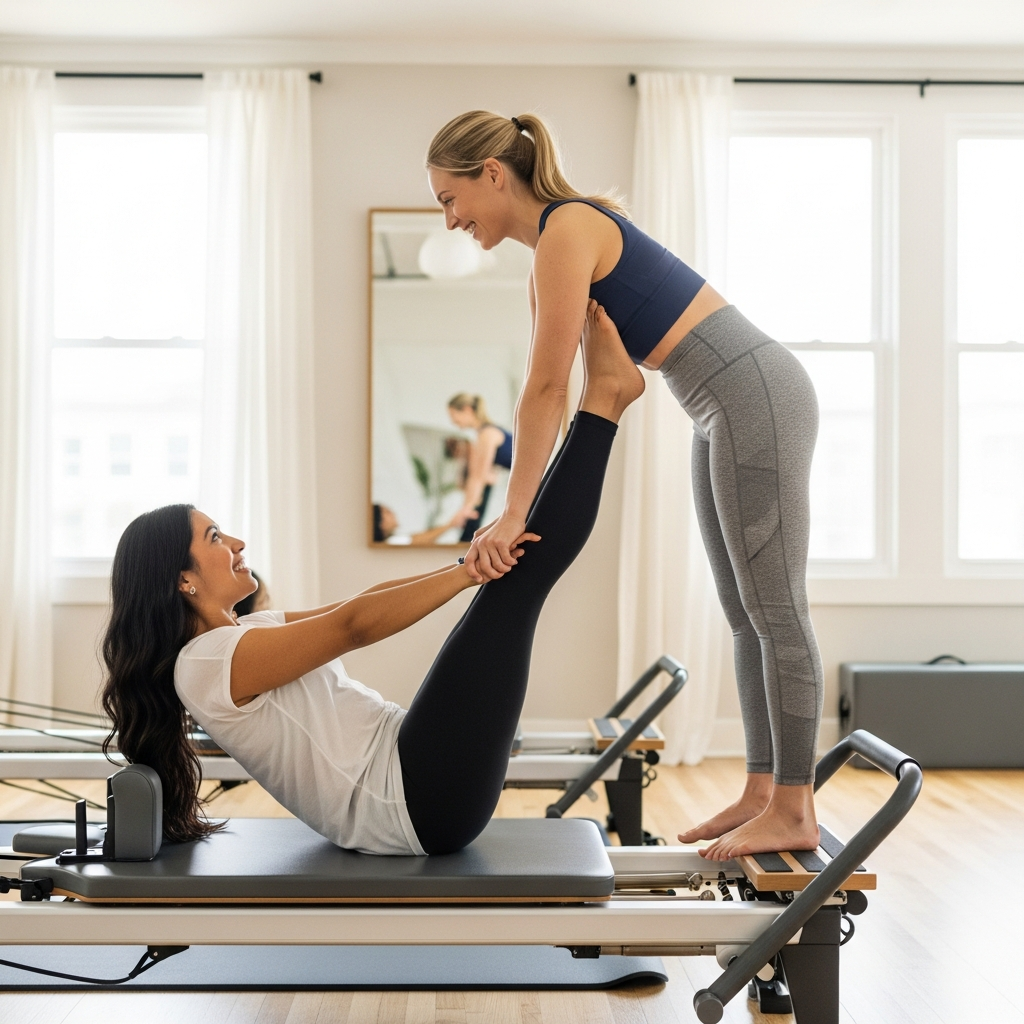
The Reformer is a bed-like frame with a flat platform on it, called the carriage, which rolls back and forth on wheels within the frame. The carriage is attached to one end of the reformer by a set of springs. The springs provide choices of differing levels of resistance as the carriage is pushed or pulled along the frame. The carriage has shoulder blocks on it that keep a practitioner from sliding off the end of the reformer as they push or pull the carriage.
But, is Reformer Pilates hard for beginners? To answer this question, it’s crucial to understand the fundamentals and framework of Pilates and its reformer variant.
Pilates focuses on small movements that require control and precision, and its health benefits include improved flexibility, increased muscle strength and tone, particularly your core muscles – abdomen, lower back, hips and buttocks (the ‘powerhouse’ muscles). It also enhances muscular control of your back and limbs.
Reformer Pilates is a method that follows these fundamental principles but adds an additional challenge through the use of the apparatus – the Reformer. This machine adds resistance to the Pilates exercises via the use of the springs which can be adjusted at different levels to increase or decrease difficulty.
The use of the Reformer creates a dynamic and challenging environment for exercising, which can be highly beneficial in terms of muscle toning, overall strength, postural alignment, flexibility, balance and body awareness. Consequently, it’s a highly effective way to transform the body.
However, this does not necessarily mean it’s hard for beginners. As with any new exercise regimen, your initial experience with Reformer Pilates can feel challenging as your body adapts to new movements and techniques. The beauty of the Reformer machine is that it can be adjusted to suit any fitness level. The adjustable springs allow for progressive levels of resistance, making the exercise as easy or as hard as one desires.
Moreover, Pilates is founded on six principles: centering, concentration, control, precision, breath, and flow. These principles guide all forms of Pilates and provide the framework for all the movements. Understanding and focusing on these principles can make the learning process easier for beginners.
Centering refers to bringing the focus to the center of the body, the powerhouse area between the lower ribs and pubic bone. All Pilates exercises are sourced from this area.
Concentration promotes the mind-body connection crucial in Pilates. Each exercise must be performed with full attention.
Control speaks to the idea that each exercise is done with muscular control. No body part is left to its own devices.
Precision is essential in Pilates. The focus is on doing one precise movement rather than many halfhearted ones.
Breath is instructed to be in sync with the movement, and practitioners are encouraged to use their breath effectively during each exercise.
Flow ensures that the exercises are done in a flowing, smooth style. Grace and balance result from the focus on smooth movement.
In conclusion, Reformer Pilates can be challenging for beginners due to its unique combination of strength, flexibility, and concentration. However, it is not insurmountably hard. With a qualified instructor who can guide you through the principles and techniques of Pilates and adjust the Reformer to your level of fitness, beginners can find Reformer Pilates an enormously rewarding and transformative journey. It is a discipline that not only strengthens the body but also focuses on the mind-body connection, making it a holistic choice for anyone looking to improve their overall fitness.
Is Reformer Pilates Hard For Beginners? A Practical Guide
Reformer Pilates, named after the special equipment on which it is performed, is a popular choice among fitness enthusiasts. The reformer machine, invented by Joseph Pilates himself, enhances the workout by adding resistance to the Pilates exercises via the use of the springs which form part of the machine. But is reformer Pilates hard for beginners? Let’s delve into this topic with some practical insights and actionable advice.
As a beginner, you may find Reformer Pilates challenging due to the unfamiliarity of the equipment and the coordination required. However, it’s important to remember that every new exercise routine comes with its own set of challenges and Pilates is no different. It’s all part of the learning process.
1. **Understanding the Reformer Machine**
The reformer machine may seem intimidating at first glance. It consists of a carriage that moves back and forth along tracks, springs for resistance, straps for feet or hands, and a footbar. Before you start your first class, familiarize yourself with these components. Knowing what each part does will make your first class less daunting.
2. **Starting with Mat Pilates**
If you’re completely new to Pilates, it’s generally recommended to start with mat Pilates. This will help you understand the basic principles such as centering, concentration, control, precision, breath, and flow. Mat Pilates will build your strength and flexibility, preparing you for reformer exercises.
3. **Taking a Beginner’s Class**
Most studios offer beginner classes for Reformer Pilates. In these classes, instructors focus on teaching the basics: how to use the reformer machine, basic exercises, and proper form. They’ll also modify exercises to accommodate different fitness levels. It’s a great way to ease into the practice without feeling overwhelmed.
4. **Listening to Your Body**
Reformer Pilates is about control and precision, not speed. As a beginner, it’s essential to listen to your body and not push beyond your limits. If you’re experiencing pain or discomfort, let your instructor know. They can adjust the exercise or offer modifications.
5. **Consistency is Key**
You might not feel like a pro after your first class – and that’s okay. Consistency is what matters most in Pilates. With regular practice, you’ll become more comfortable with the reformer machine and exercises. You’ll also notice improvements in your strength, flexibility, and balance.
6. **Taking Private Lessons**
If you’re still finding Reformer Pilates challenging after several classes, consider taking a few private lessons. A one-on-one session with a certified instructor can provide personalized attention and help you understand the nuances of the reformer exercises.
7. **Practicing Patience**
Pilates is a journey, not a destination. It’s about improving your mind-body connection, enhancing your physical fitness, and boosting your overall wellbeing. Remember to be patient with yourself as you navigate this new fitness terrain.
To illustrate, let’s consider Sarah’s experience as a beginner. She had been practicing mat Pilates for two months before deciding to try Reformer Pilates. Despite her prior experience, she found her first reformer class challenging: the machine was unfamiliar, and the exercises required more coordination. However, Sarah didn’t let this discourage her. She continued attending classes regularly, listening to her body, and communicating with her instructor. After a few weeks, Sarah felt more comfortable on the reformer machine and noticed improvements in her core strength and posture.
In conclusion, while Reformer Pilates can initially be challenging for beginners, it is by no means insurmountable. With patience, consistency, and the right approach, you’ll soon grow accustomed to this enriching form of exercise. Remember, every expert was once a beginner. Embrace the learning process and enjoy your journey towards improved fitness with Reformer Pilates.
Reformer Pilates for Beginners: Challenges, Solutions, and Expert Tips
Reformer Pilates is an excellent fitness regimen designed to improve strength, flexibility, coordination, and balance. However, beginners may find it intimidating due to the complicated-looking equipment and intricate movements. Here, we debunk misconceptions, explore common challenges, offer solutions, and share expert tips to ease your transition into Reformer Pilates.
Misconceptions about Reformer Pilates
The biggest misconception about Reformer Pilates is that it’s only for the highly fit or experienced athletes. This couldn’t be further from the truth. Reformer Pilates is adaptable to all fitness levels. The use of a reformer machine, with its system of springs and pulleys, allows for dynamic resistance that can be adjusted to suit any fitness level.
Common Challenges for Beginners in Reformer Pilates
1. Handling the Equipment: The reformer machine might seem complex at first glance. It’s not your regular fitness equipment and requires a certain level of familiarity.
2. Body Awareness: As Reformer Pilates involves precise movements, beginners may find it challenging to coordinate their body movements initially.
3. Posture and Alignment: Maintaining the correct posture and alignment throughout the exercises can be tricky for beginners.
Solutions and Best Practices
1. Understanding the Equipment: The most effective way to overcome equipment-related challenges is to learn about the reformer machine. An introductory class or private session can be very helpful in understanding the apparatus’s functionality.
2. Building Body Awareness: Practice makes perfect. The more you practice, the more aware you become of your body movements. Start with simple exercises and gradually move to more complex ones as your strength and coordination improve.
3. Correcting Posture and Alignment: Always prioritize quality over quantity. It’s better to perform fewer repetitions correctly than many with poor form. A qualified instructor can guide you in maintaining proper posture and alignment.
Expert Tips for Beginners
1. Start Slow: Don’t rush into advanced exercises. Begin with basic movements to familiarize yourself with the reformer and gradually progress as your strength, flexibility, and coordination improve.
2. Listen to Your Body: Pilates is about control and precision, not about pushing your body to the limit. If you feel any discomfort or pain, stop the exercise and consult with your instructor.
3. Regular Practice: Consistency is key in Pilates. Regular practice helps build muscle memory, making the exercises easier over time.
4. Personalize Your Workout: The beauty of the reformer machine is its adaptability. You can adjust the resistance according to your comfort level. Don’t hesitate to personalize your workout under the guidance of your instructor.
5. Stay Hydrated: Like any other workout, hydration is crucial in Pilates too. Drink water before, during, and after your session to stay hydrated.
When compared to Mat Pilates, Reformer Pilates might seem more challenging initially due to the use of equipment. However, the reformer machine provides a structured framework for exercising, making it easier to perform movements with precision and control.
In conclusion, while Reformer Pilates may seem hard for beginners, with consistent practice, proper guidance, and an understanding of the equipment, anyone can master it. Remember that every expert was once a beginner – don’t be discouraged if you find it hard initially. With time, you’ll start enjoying the benefits of increased strength, flexibility, and overall fitness that Reformer Pilates brings.
Is Reformer Pilates Hard for Beginners? A Comprehensive Guide
Pilates, a fitness regimen developed in the early 20th century by Joseph Pilates, has been gaining significant popularity in recent years, owing to its focus on core strength, balance, and flexibility. While mat Pilates is the most common form, Reformer Pilates is quickly becoming a favorite among fitness enthusiasts. However, a question often asked by beginners is: “Is reformer Pilates hard?”
Reformer Pilates involves a special machine with a flat platform that moves along a track within a frame. The platform is attached to one end of the frame with a set of springs, which can be adjusted to increase or decrease resistance. The apparatus also includes straps for your hands or feet and a foot bar. The exercises on the reformer can be done lying down, sitting, standing, pulling the straps, pushing the foot bar, perched on the foot bar, or even upside down.
As a beginner, you might find the reformer machine itself quite intimidating. It’s complex and different from your typical gym equipment. However, don’t let this deter you. With proper guidance and gradual progress, you can master the machine and enjoy the benefits Reformer Pilates offers.
Expectations and Timelines for Beginners
1. Initial Phase: Familiarization and Adaptation
The initial phase of your Reformer Pilates journey will involve familiarizing yourself with the equipment and understanding its mechanics. Even if you have done mat Pilates before, the reformer is a whole new ball game. The first few sessions will be about learning how to adjust the springs, use the straps, and move on the carriage.
For beginners, the initial series of exercises will focus on getting used to the movement patterns and control required for Reformer Pilates. You might not feel like you’re getting a strenuous workout at this stage, but these foundational exercises are crucial in preparing your body for more advanced movements.
2. Mid Phase: Building Strength and Confidence
As you get comfortable with the reformer, your instructor will start introducing more complex exercises. These could involve more dynamic and strength-based movements, challenging your balance and coordination. This phase would typically start around your 4th to 6th session and continue for a few weeks.
You’ll gradually see improvements in your posture, flexibility, and core strength. It’s essential to maintain regularity in your sessions to ensure continuous progress.
3. Advanced Phase: Mastery and Progression
After approximately 12 to 15 sessions, you should have gained enough confidence and strength to tackle more advanced moves. Your instructor will customize the routines to match your skill level and fitness goals.
Remember, Reformer Pilates is not about speed but precision and control. Don’t rush through this phase; take your time to master each exercise before moving on to the next.
Next Steps:
1. Find a Certified Instructor: As a beginner, it’s crucial to train under a certified Pilates instructor who can guide you through the basics, correct your form, and prevent potential injuries.
2. Start with Private Sessions: If possible, start with a few private sessions. This allows the instructor to focus entirely on you, helping you understand the reformer machine and the basic Pilates principles.
3. Join Group Classes: Once you’re comfortable with the basics, you can join group classes. These are not only more economical but also offer a sense of camaraderie, making the sessions more enjoyable.
4. Consistency is Key: Try to attend at least two or three sessions per week. Consistency is vital to see improvements and progress to advanced levels.
5. Listen to Your Body: Each person’s body responds differently to exercise. If something doesn’t feel right or you’re experiencing discomfort beyond normal muscle soreness, speak up.
In conclusion, while Reformer Pilates may seem overwhelming at first, it’s not as hard as it appears. With proper guidance, patience, and consistency, you can make significant strides in your fitness journey. So, take that leap, try out a class, and you might just find your new favorite workout.
In conclusion, it’s essential to understand that beginner-level Reformer Pilates is not as intimidating or challenging as it may initially appear. Yes, it requires a certain level of physical exertion and mental focus, but it’s designed to be accessible, manageable, and beneficial for individuals at all fitness levels, even those who are just starting out.
The key takeaways from this discussion are
1. **Understanding the Reformer:** The Pilates Reformer – a specialized piece of equipment featuring a sliding carriage and adjustable springs to regulate tension and resistance – is not as daunting as it may look. Once you understand its purpose and how it works, you’ll see that it’s an incredibly versatile tool designed to adapt to your unique needs and goals.
2. **Learning Curve:** Like any new endeavor, there’s a learning curve involved when starting Reformer Pilates. You’ll need to become familiar with the equipment, learn various exercises, and cultivate body awareness. However, with a qualified instructor guiding you and a commitment to regular practice, you’ll soon see your proficiency increase.
3. **Progress at your own pace:** Reformer Pilates is not about pushing your body to its limits or competing with others. It’s about understanding your body’s current abilities and gradually expanding them over time. Everyone progresses at different rates, and that’s okay. The key is consistency and patience with your body.
4. **Benefits for beginners:** Beginners can reap a multitude of benefits from practicing Reformer Pilates, including improved strength, flexibility, balance, and posture. Additionally, it can enhance your mind-body connection, boost your self-confidence, and reduce stress levels.
5. **Professional guidance:** It’s crucial for beginners to start their Reformer Pilates journey under the expertise of a certified instructor. They can ensure correct form, prevent injuries, and customize workouts to suit your individual needs and goals.
So, is Reformer Pilates hard for beginners? It can be challenging, yes – but in a positive, growth-promoting way. It’s about stepping out of your comfort zone, exploring your body’s capabilities, and consistently working towards improvement. And remember, ‘hard’ doesn’t mean ‘impossible.’ With the right mindset, guidance, and commitment, you’ll see that what once seemed difficult becomes doable – and even enjoyable.
Embarking on your Reformer Pilates journey is an investment in your health and wellbeing. It’s about taking proactive steps towards a stronger, fitter, more balanced you. And the beauty of it is, you don’t have to do it alone.
We encourage you to reach out to us for assistance and guidance. Our team of dedicated, certified instructors is here to support you every step of the way – from your first session to the realization of your fitness goals. We offer beginner-friendly classes that provide the necessary support and instruction to help you navigate this exciting new journey with confidence and ease.
Reformer Pilates may be hard at first, but with our help, you can turn this challenge into a rewarding journey of self-discovery, growth, and transformation. So why wait? Contact us today and let’s get started on your Reformer Pilates journey together.