Ryan Place Pilates Classes: Small Group vs Private Sessions
You’ve been staring at the schedule for ten minutes. Private session or small group class – how different can they really be? It’s just Pilates, right?
Except… it’s not just Pilates. And somewhere in the back of your mind, you already know that. That’s probably why you’re still staring at the screen.
Here’s a scenario that might feel familiar. You sign up for a group fitness class – any class, could be yoga, barre, cycling – and you show up genuinely excited. The instructor is great, the energy is good, and you’re moving your body. But three weeks in, you realize you’ve been doing that one exercise slightly wrong the whole time. Nobody mentioned it. Nobody had the chance to mention it. There were fourteen other people in the room, and the instructor was doing their best to keep everyone moving, motivated, and safe all at once. You weren’t getting worse, exactly. But you weren’t getting *better* the way you hoped you would.
That experience? It’s more common than you’d think. And it’s exactly why the question of how you practice Pilates – not just whether you practice it – matters so much more than most people realize when they’re just getting started.
Why This Decision Is Actually Kind of a Big Deal
Ryan Place Pilates has built something genuinely special in Fort Worth. Small, intentional, community-minded. The kind of studio where the instructors actually learn your name and remember that your left hip is tighter than your right. But even within that environment, there’s a meaningful choice to make about how you want to show up – and what you’re hoping to get out of it.
Small group classes and private sessions aren’t just two different price points for the same experience. They’re two different *experiences* entirely. Different energy, different pacing, different relationships with your instructor, and honestly? Different results depending on what you’re working toward. Choosing between them without understanding that is a little like picking a restaurant based entirely on the font of the menu. You might get lucky. Or you might end up somewhere that doesn’t quite fit.
The thing is, most people just go with whatever feels less intimidating – which is usually the group class, because showing up alone in a room with an instructor feeling watched and evaluated for sixty minutes sounds mildly terrifying. (It’s really not, for what it’s worth. But we’ll get to that.)
What You’re Actually Going to Learn Here
This article is going to walk you through the real differences between small group Pilates classes and private sessions at Ryan Place Pilates – not in a dry, bullet-point comparison kind of way, but in the way a friend who’s been through both would explain it to you over coffee.
We’re talking about what the actual experience feels like in the room. How each format handles things like injury history, specific goals, or that nagging back issue you’ve been managing for years. We’ll get into the cost question too, because pretending money isn’t part of this conversation would be a little silly – but we’ll also put it in context, because “cheaper” and “better value” aren’t always the same thing.
You’ll also get a clearer picture of who tends to thrive in each setting. Because here’s the honest truth – there isn’t a universally *right* answer. Some people genuinely flourish in the energy and community of a small group. Others need the focused, one-on-one attention of a private session to finally break through a plateau they’ve been stuck on for months. And a lot of people? They do both, in a rhythm that works for their life and their body.
By the time you’re done reading this, you should have a much clearer sense of which path makes sense for *you* – not some hypothetical ideal Pilates person, but you, with your schedule, your goals, your history, and your budget.
Because ultimately, the best Pilates practice is the one you actually show up for consistently. And finding the right format is a big part of making that happen.
So let’s figure out what that looks like for you.
What Pilates Actually Is (And Isn’t)
If you’ve never tried Pilates before, you might have a vague mental image of people doing impossibly graceful movements on strange-looking equipment while wearing expensive athleisure. And honestly? That’s… not entirely wrong. But it misses the point by a mile.
Pilates is a system of movement developed in the early 20th century by Joseph Pilates – a fascinating, slightly eccentric man who called his method “Contrology.” The core idea is that movement should originate from a strong, stable center (what practitioners call the “powerhouse,” roughly your deep core muscles), and that the connection between your mind and your body matters just as much as the physical effort itself. It’s less about burning calories and more about teaching your body to move the way it was actually designed to.
Think of it like recalibrating a car’s alignment. You could keep driving with the wheels slightly off – and plenty of people do, for years – but once everything lines up correctly, the whole ride changes.
The Equipment Situation (It’s Less Intimidating Than It Looks)
Here’s where people get confused, and understandably so. Pilates has two main worlds: mat work and apparatus work, and they coexist in ways that can seem contradictory at first.
Mat Pilates is essentially what it sounds like – a series of exercises done on the floor, using your own bodyweight as resistance. It’s accessible, requires no special equipment, and is genuinely challenging despite looking deceptively simple from the outside. Don’t let anyone tell you mat work is the “beginner” version. Some of the hardest Pilates exercises ever invented are pure mat work.
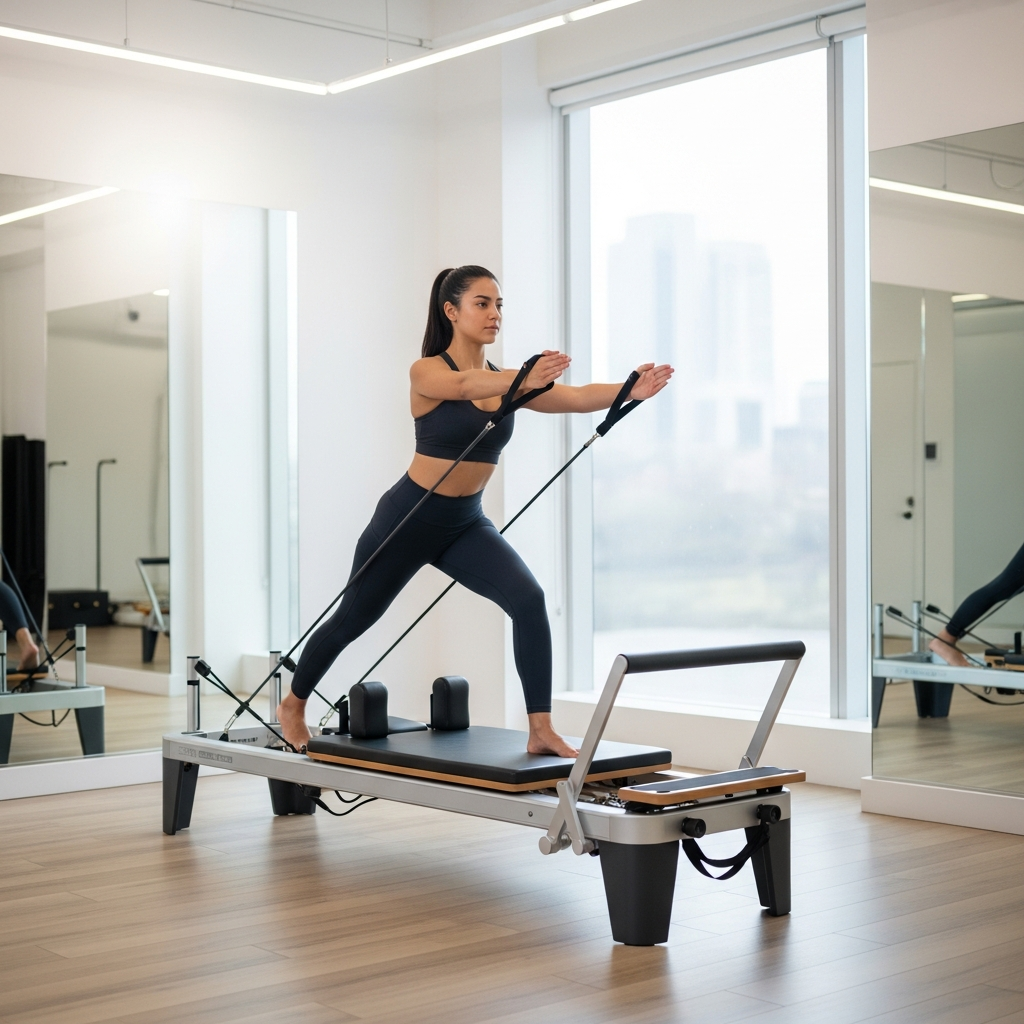
Then there’s the apparatus – and the Reformer is the one you’ve probably seen. It’s that bed-like contraption with springs and straps and a sliding carriage. There are also pieces called the Cadillac (yes, really), the Wunda Chair, and several others. The springs provide both assistance and resistance, which is actually where it gets a bit counterintuitive: more spring tension doesn’t always mean harder. Sometimes it means the opposite. The springs can support you through a movement, making it more accessible, or they can create resistance that demands more from your muscles. Your instructor adjusts this based on exactly what you need.
Ryan Place Pilates works primarily with Reformers and mat, which is honestly the ideal combination for most people – enough variety to keep things interesting, enough consistency to actually build skill over time.
Why It Works Differently Than Other Exercise
Most exercise we’re familiar with is pretty straightforward: do more, lift heavier, go faster, get fitter. Pilates operates on a different logic entirely, which is why it sometimes frustrates people who are used to grinding through tough workouts.
The emphasis here is on precision over repetition. You might do six repetitions of something in Pilates where you’d do thirty in a traditional gym class. But those six reps, done with proper form and genuine muscular engagement? They ask more of your nervous system than a mindless set of thirty ever would. It’s the difference between having a real conversation with someone and just talking at them.
This is also why Pilates has such an unusually broad fan base – professional athletes, people recovering from injuries, older adults wanting to stay mobile, new moms trying to reconnect with their bodies after pregnancy. The principles are the same for everyone; the application just looks different. Actually, that’s one of the things that makes the small group versus private question so interesting, because how those principles get applied to *you specifically* is really the whole conversation.
The Mind-Body Thing Is Real (Even If It Sounds Like Wellness Speak)
Look, “mind-body connection” can sound like something you’d read on a scented candle. But in Pilates, it has a very practical meaning. You’re constantly being asked to think about what your muscles are doing, where your spine is in space, whether you’re gripping here and releasing there. It demands a different kind of attention than most physical activity.
For a lot of people, that mental engagement is actually a relief. An hour of Pilates is an hour where you genuinely cannot think about your email. Your brain is just… occupied. Which, depending on your stress levels, might be worth the membership fee all by itself.
How to Actually Choose What’s Right for You
Here’s the thing most studios won’t tell you upfront: the “best” option isn’t about budget or scheduling – it’s about where you are in your body right now. If you’re coming in with a specific issue – a herniated disc, post-surgical rehab, hypermobility, scoliosis – start with privates. Full stop. A small group class, even a well-taught one, simply cannot give your instructor enough eyes on your particular quirks. You need someone building a program *around* you before you join a room full of other people.
If you’re a generally healthy person who just wants to get stronger, move better, and actually show up consistently? Small group is probably your starting point. And honestly, the accountability factor alone is worth it – there’s something about knowing six other people will notice if you disappear.
The “Try Before You Commit” Strategy
Don’t sign up for a package until you’ve done at least one intro private session. Most Ryan Place instructors offer these, and they’re genuinely worth the investment even if you plan to go the small group route long-term. Think of it like getting a fitting before you buy the suit. That single session gives your instructor a baseline – your posture patterns, your tight spots, any movement compensations you’ve developed over years of sitting at a desk or favoring one side.
Then when you walk into a small group class, the instructor already knows you. They know your left hip flexor is grabby, or that you tend to hold your breath during abdominal work. That context changes everything.
Making Private Sessions Count
If you do go the private route – either temporarily or long-term – come prepared to be honest. Embarrassingly honest. Tell your instructor about the things you think are irrelevant: the old ankle sprain from 2009, the way you sleep on your stomach, the fact that you sit cross-legged at your desk all day. These things aren’t irrelevant. They’re the whole story.
Also, take notes after your sessions. Not during – you’ll lose focus – but right after, in your car or on your phone before you drive away. Jot down the two or three cues that clicked for you. Pilates is notoriously hard to retain if you don’t reinforce it between sessions, and your instructor will be genuinely impressed when you show up the following week having actually practiced what they gave you.
Getting the Most from Small Group Classes
Small group doesn’t mean passive. This is your workout – you’re not just along for the ride. If a cue isn’t landing, ask. Good instructors expect questions and frankly appreciate them. It makes the whole class better.
Show up a few minutes early and tell your instructor anything that’s different that day – you slept weird, your lower back is cranky, you’ve got a headache. Even in a group setting, a skilled instructor will quietly modify your work or keep a closer eye on you. They can’t help you if they don’t know.
One practical tip that sounds almost too simple? Claim the same spot every class. It sounds superstitious, but there’s real logic here. Your instructor learns your patterns faster when they’re watching you in consistent context. And honestly, you’ll feel less distracted when you’re not recalibrating to a new piece of equipment every time.
The Hybrid Approach (And Why It Might Be the Sweet Spot)
A lot of committed Pilates people land here eventually: one private session every three to four weeks, combined with regular small group classes. The private session becomes a kind of tune-up – a chance to troubleshoot whatever plateau or pattern has crept in, and to get new material to work with in class.
Actually, if you’re serious about seeing results, this combination tends to outperform either option alone. The group classes give you frequency and consistency. The privates give you precision. Together? That’s where things start to really shift.
The cost works out more reasonably than you’d think, especially if you space privates strategically – after a new session block begins, or when you’re learning a new piece of equipment like the Cadillac or Wunda Chair for the first time.
Whatever you choose, just start. The “perfect” plan you never begin beats exactly nothing.
When Real Life Gets in the Way
Let’s be honest – starting any new fitness routine is way harder than it looks on Instagram. Pilates is no exception. And at Ryan Place, whether you choose small group or private sessions, you’re going to hit some bumps. That’s not pessimism. That’s just… reality. The good news is that most of these challenges are incredibly common, which means there are actual, tested solutions for them.
The Scheduling Trap
Small group classes run on a fixed schedule. Sounds simple enough, right? Except then your boss schedules a 6pm meeting on your Tuesday class night, your kid gets sick on a Thursday, and suddenly you’ve missed two weeks and the guilt spiral begins.
This is genuinely the number one reason people quietly disappear from group fitness. Not boredom, not injury – inconsistent attendance that snowballs into abandonment.
The practical fix here is less glamorous than you’d hope. Book your spot the moment the schedule opens. Treat it exactly like a medical appointment you’d reschedule around, not skip entirely. And if you’re someone who travels for work or has an unpredictable home life, it’s worth being real with yourself about whether a private session package – where you schedule around your life instead of around a fixed class – might actually get you better results through pure consistency.
“I Feel Like Everyone’s Watching Me”
Oh, this one. If you’ve walked into a small group class and felt like the only person who doesn’t already know what a “neutral spine” is… you’re in extremely good company. That feeling of being the most lost person in the room is almost universal for new students, and it’s deeply uncomfortable.
Here’s what’s actually true though – everyone else is focused on their own bodies, their own breathing, their own slightly-wobbly single-leg stretch. Nobody is cataloguing your mistakes.
That said, feelings aren’t always swayed by facts. If self-consciousness is genuinely holding you back from getting anything out of a class, a few private sessions to build your foundation first isn’t a luxury – it’s a strategy. Come into a small group class already knowing the vocabulary and the basic movements, and the whole experience shifts.
Progress That Feels Invisible
Pilates progress is sneaky. Unlike lifting weights where you can literally add plates to the bar and measure improvement, Pilates gains tend to show up in subtler ways – your lower back stopped aching on Tuesday mornings, you stood straighter without thinking about it, that move that used to be impossible suddenly… isn’t.
Private session clients often track progress more clearly because their instructor is watching one person and can name specific improvements out loud. In a small group, that feedback is more diffuse.
If you’re in group classes and feeling stuck, actually ask your instructor after class. Something simple like “I’ve been working on my hip flexor tension for three weeks – am I getting anywhere?” opens a conversation that wouldn’t otherwise happen. Good instructors remember more than you’d think.
The Comparison Problem
Small groups are wonderful until they’re not. Until there’s someone next to you who is annoyingly flexible, who’s been coming for four years, whose teaser looks effortless while yours looks like a determined but confused caterpillar.
Comparison genuinely derails people. It shifts your focus from your body to someone else’s, which is almost the opposite of what Pilates is asking you to do.
Actually, that’s a useful reframe – Pilates is fundamentally an internal practice. The whole point is proprioception, body awareness, connecting breath to movement. Watching someone else do it better pulls you out of that entirely. When you catch yourself comparing, treat it as a signal to go back inward. Easier said than done, sure. But worth practicing.
When Something Hurts
Not the good burn – actual pain, discomfort, something that doesn’t feel right. This gets ignored far too often because people feel awkward stopping or modifying mid-class.
Don’t. Just don’t push through joint pain or sharp sensations hoping it’ll resolve. Tell your instructor immediately, even in a group setting. A good Pilates instructor would so much rather pause and offer you a modification than have you quietly injure yourself and never come back.
Private sessions do have an edge here – your instructor sees everything and will likely catch compensations before they become problems. But in either format, speaking up is always the right call.
What to Actually Expect (And When)
Let’s be honest for a second – because you deserve that more than you deserve a bunch of hype. Pilates works. It genuinely does. But it’s not magic, and the timeline for seeing results is probably longer than the Instagram posts would have you believe.
Most people notice something in the first two to three weeks, but it’s rarely what they expected. It’s not usually “wow, I look different.” It’s more like… you got up from your desk and realized your lower back didn’t ache. Or you caught your posture in a storefront reflection and something was different. Those small moments? That’s the work showing up.
Visible changes in strength and body composition typically take six to eight weeks of consistent practice – and that’s assuming you’re showing up regularly, not just once in a while when you remember. That’s normal. That’s not a failure of the method or a failure of you. It’s just how bodies work.
The First Few Sessions Feel Awkward. That’s Fine.
Whether you’re starting with a private session or jumping into a small group class, there’s a learning curve that nobody really warns you about. Pilates has its own language – neutral spine, imprint, lateral breathing – and for the first week or two, you might feel like everyone else got a memo you didn’t.
You’ll probably also feel muscles you genuinely didn’t know you had. There’s a specific kind of soreness that Pilates produces – not the brutal can’t-walk-tomorrow kind (usually), but this deep, subtle fatigue in places like your inner thighs or the muscles around your shoulder blades. It’s disorienting if you’re used to more traditional workouts.
Actually, that reminds me of something worth saying: if you’ve been a runner or a gym-goer for years, you might find the early sessions almost frustratingly slow. Stick with it anyway. The precision is the whole point.
Private Sessions vs. Small Group: The Realistic Timeline Difference
Here’s where it matters which path you choose. In private sessions, progress tends to happen faster in the beginning – your instructor can spot compensations and bad habits before they become ingrained, and they’re building a program specifically for your body. If you’re recovering from an injury or dealing with chronic pain, this head start is genuinely worth the higher price.
Small group classes move at a shared pace, which is wonderful for community and motivation but means your instructor can’t always catch that your right hip is hiking up every time you do a single leg stretch. You’ll get there – it just might take a few more weeks to develop the body awareness that private clients build a little faster.
Neither is wrong. They’re just different.
A Realistic Month-by-Month Picture
Weeks one through four: You’re learning. Your brain and body are figuring out how to talk to each other. This phase can feel humbling, especially if you’re used to being “good” at exercise.
Weeks five through eight: Something starts clicking. Movements that felt impossible become manageable. You might notice you’re sleeping better, or that you’re breathing differently during stressful moments. Your instructor will notice changes in your movement patterns even before you do.
Months three and beyond: This is where the real shifts happen. Postural changes become more obvious. Strength accumulates in a way that feels different from other training – more integrated, less isolated. People in your life might start commenting that you seem different, even if they can’t quite put their finger on why.
What You Can Do to Set Yourself Up Well
Show up consistently – that matters more than almost anything else. Two to three sessions per week is the sweet spot for most people, though even once a week beats nothing if that’s what your life allows right now.
Tell your instructor what’s going on with your body. Not just injuries, but how you slept, whether you’re stressed, if something felt weird last time. The more information they have, the more useful they can be.
And genuinely – try not to compare your week three to someone else’s week twelve. Every body comes in with a different history, different tensions, different compensations built up over years. Your progress is your own.
If you’re ready to book a session or just want to talk through which format makes sense for where you’re starting, the Ryan Place team is easy to reach and genuinely good at helping people figure out the right fit. No pressure. Just a conversation.
Whether you’re drawn to the energy of a small group or the focused attention of a one-on-one session, the most important thing to remember is this: there’s no wrong answer here. Honestly. Both paths lead to the same destination – a stronger core, better movement patterns, and that satisfying feeling when something your body couldn’t do last month suddenly clicks into place.
It can feel like a big decision, and we get that. Choosing how to invest your time and money in your health isn’t something most people take lightly. But here’s what we’ve seen over and over again at our Ryan Place studio: the clients who make the most progress aren’t necessarily the ones who picked the “perfect” option on day one. They’re the ones who just… started. They showed up, they asked questions, and they figured out what worked for them along the way.
Your Needs Will Change – And That’s a Good Thing
One thing worth remembering is that where you begin doesn’t have to be where you stay. A lot of people start with private sessions to build their foundation – learning the vocabulary of the work, understanding how their body moves, getting comfortable with the equipment – and then transition into small groups when they’re ready for that shared energy. Others do the opposite. They love the community of a group class and later add private sessions when they want to dig into something specific, like recovering from an injury or preparing for a sport. There’s no rule that says you have to choose one lane and stay in it forever.
You Deserve Support That Actually Fits You
What we really want you to walk away knowing is that you deserve an approach that fits your actual life – your schedule, your budget, your comfort level, your goals. Not someone else’s. Pilates isn’t a one-size-fits-all kind of practice, and neither is the way you pursue it. If you’re coming back from something physically difficult, you need something different than someone who’s training for performance. If you’re a little shy in group settings (no judgment whatsoever, by the way), that matters too.
Actually, that’s one of the things we love most about working with clients in Fort Worth – people here are refreshingly honest about what they need. They ask real questions. They don’t pretend. And that makes it so much easier to help them.
Ready to Figure Out Your Next Step?
If you’ve been sitting with this decision for a while – maybe bookmarking articles, maybe asking friends what they think – this might just be the nudge you needed. Reach out to us. Seriously, no pressure, no hard sell. Just a real conversation about where you are, what you’re hoping for, and which option might be the better fit right now.
You can call the studio, shoot us a message, or stop by if you’re in the Ryan Place neighborhood. We love meeting people right where they are.
And if you’re still not sure after talking with us? That’s okay too. We’ll help you think it through until it feels right. That’s kind of what we’re here for – not just the Pilates part, but the whole “figuring out how to take better care of yourself” part. You’ve got support here whenever you’re ready.